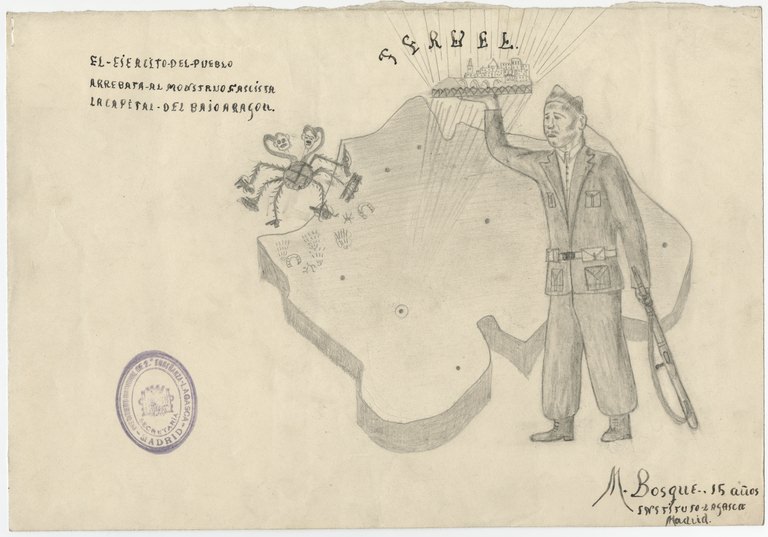
A child’s pencil lines turn the Spanish Civil War of 1936 into a stark little drama: a uniformed figure stands with an arm raised beneath the word “GREBEL,” while a rough map-like shape stretches across the page and a strange, spider-like creature hovers nearby. The simple shading, oversized symbols, and bold lettering feel less like illustration and more like a message—part imagination, part testimony—made with the directness children often bring to frightening events. Even without polished technique, the composition communicates urgency and a clear sense of sides, slogans, and threat.
Spanish text across the upper left reads like a proclamation, and the drawing’s propaganda-like tone hints at how conflict filtered into everyday speech and schoolroom perception. A circular stamp marked “Madrid” anchors the sheet as an archival object rather than a casual sketch, suggesting it was collected, preserved, and later studied as evidence of wartime experience. The mix of map, monster, and soldier compresses geography and fear into one scene, revealing how children absorbed the language of “enemy” and “victory” through the turmoil around them.
Children’s drawings from the Spanish Civil War are invaluable historical sources because they record emotion as much as events, offering a rare view of how propaganda, violence, and uncertainty were interpreted at a young age. For readers exploring Spanish Civil War artworks, this piece stands out for its handwritten slogans, symbolic figures, and documentary feel—an artifact that sits between art and witness. Viewed today, it invites careful reading: not to extract a single “correct” story, but to listen to a child’s visual vocabulary as it tried to make sense of 1936.