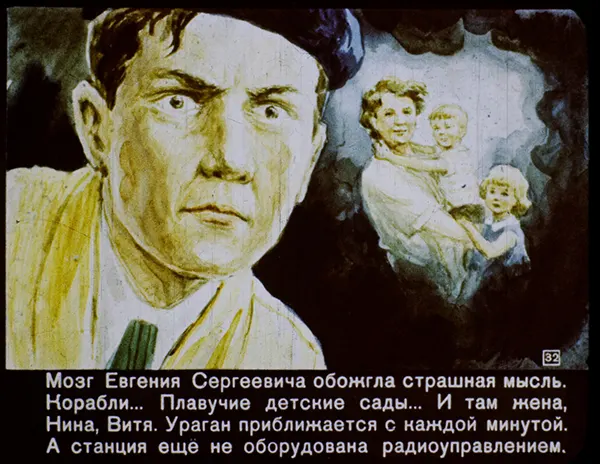
Evgeny Sergeyevich’s face dominates the frame, drawn with hard lines and a fixed stare that makes the viewer feel the pressure inside his skull. The artwork reads like a moment frozen at the edge of catastrophe: a man at a weather station, aware of danger, yet cut off from the one tool that could bridge distance and time—radio control. Even without full context, the composition communicates alarm, responsibility, and the helplessness of waiting for news.
To the side, a smaller scene hovers like a memory or a vision: a woman holding a child, another child close by, rendered softer and lighter than the main portrait. That contrast sets up the title’s terrible equation—family and “floating kindergartens” out on the water, ships exposed as a hurricane draws nearer “with every minute.” The Russian caption at the bottom reinforces the narrative tone, giving the piece the feel of an illustrated story panel or propaganda-era graphic, where text and image work together to heighten urgency.
For readers searching for historical illustrations, Soviet-era graphic art, or weather station themes in visual culture, this post offers a gripping example of how disaster anxiety was dramatized on the page. The tight focus on expression, the storm-dark background, and the looming idea of communication failure turn a simple portrait into a broader meditation on technology, duty, and family at risk. It’s a stark reminder that in many historical narratives, the most frightening moments happen not in the storm itself, but in the minutes before contact is lost.