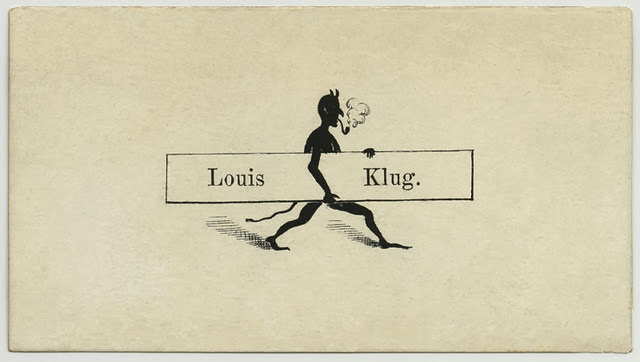
Polite society in the 19th century had plenty of rules about who could speak first, how introductions should be made, and what counted as “proper” behavior—so it’s no surprise that humor found a way to slip through the cracks. The era’s acquaintance cards (often called “ice-breakers”) offered a playful shortcut, letting strangers trade a joke before they traded real conversation. In a world of formal calling cards, these witty little prints worked like social permission slips.
Across the center of this card, the name “Louis Klug.” sits inside a neat rectangular label, while a mischievous silhouetted figure strides along the top edge, as if carrying or presenting the identity itself. The minimal design does the heavy lifting: bold contrast, clean typography, and a cartoonish character that reads instantly, even at a glance. It’s a compact example of how Victorian and late-19th-century graphic humor could turn something as stiff as an introduction into a visual punchline.
Collectors and historians value pieces like this for what they reveal about everyday etiquette, print culture, and the timeless need to break the ice. Whether you’re researching antique calling cards, 19th-century humor, or the origins of social “icebreaker” traditions, this acquaintance card shows how a simple gag could open doors—literally and socially. Seen today, it feels surprisingly modern: a quick, shareable joke attached to a name, meant to make a stranger smile.