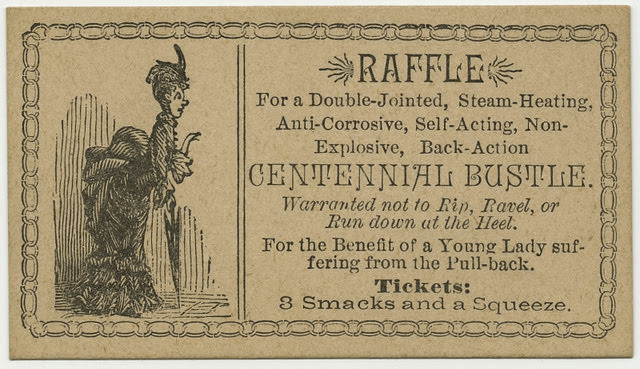
A wry little “RAFFLE” card like this tells you a lot about how 19th‑century people mixed humor with manners when meeting strangers. Set in a decorative border, the scene pairs a small caricature at the left with bold, attention-grabbing lettering at the right, mimicking the look of a public notice while quietly inviting a laugh. It’s the sort of novelty that could be slipped into a conversation—part gag, part introduction, and entirely designed to spark a reaction.
The printed pitch is delightfully overbuilt: a “Centennial Bustle” touted with an absurd stack of features—“double-jointed,” “steam-heating,” “anti-corrosive,” “self-acting,” even “non-explosive”—as if a piece of fashion could be sold like a machine. The jokes keep piling on, from the promise it’s “warranted not to rip” to the tongue-in-cheek mention of a “young lady suffering from the pull-back,” turning the language of patents and advertisements into social comedy. Even the price—“Tickets: 3 Smacks and a Squeeze”—leans into playful, flirt-adjacent phrasing without saying anything outright.
For readers exploring humorous acquaintance cards, icebreaker ephemera, and Victorian-era social customs, this example works like a miniature time capsule of courtship-era wit and consumer satire. The exaggerated typography, the mock-technical vocabulary, and the cheeky “raffle” premise all point to a culture that enjoyed jokes in print—portable entertainment meant for pockets, parlors, and quick introductions. Seen today, it remains a clever reminder that long before modern memes, people were already using printed humor to break the ice.