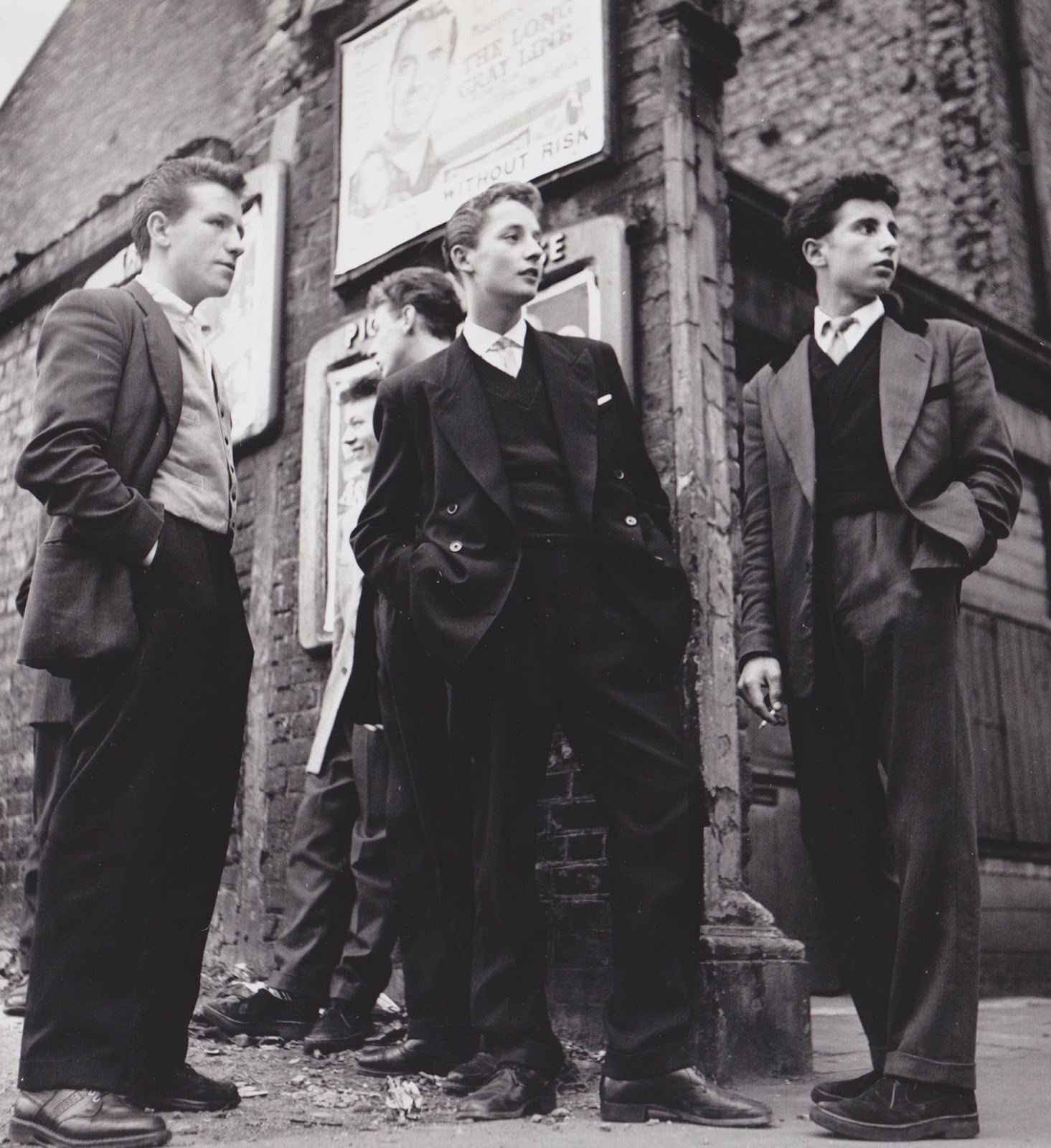
Outside the Picture House on the Old Kent Road, a small knot of Teddy Boys loiters at the edge of the pavement, framed by worn brickwork and the glow of cinema advertising boards. Their attention is angled off to the right, as if something in the street has just caught the group’s eye, and the casual stance—hands in pockets, weight on one leg—suggests the unhurried rituals of a night out. The scene has the feel of postwar London leisure: the cinema frontage as a landmark, the sidewalk as a meeting place, and youth culture finding its own stage in public.
Clothes do much of the talking here, and the silhouette is unmistakably 1950s: long drape jackets, sharp lapels, waistcoats layered over crisp shirts, and trousers cut wide through the leg. Hair is carefully sculpted into high quiffs and swept-back styles, a deliberate polish that reads as both fashion statement and social signal. Even in a candid moment, the look is composed—part Edwardian revival, part modern bravado—capturing why Teddy Boy style became one of the most photographed and debated expressions of British working-class youth.
Cinema culture and street style intersect in this single corner of the Old Kent Road, where film posters, brick, and tailoring compress into a snapshot of mid-century urban life. The Picture House served as more than entertainment; it was a social hub where young people could see and be seen, trading music, attitudes, and local gossip under the marquee’s promise. For anyone searching the history of Teddy Boys, 1950s London fashion, or British youth subcultures, this photograph distills an era when identity could be announced with a jacket cut and a haircut line, right outside the doors of the movies.