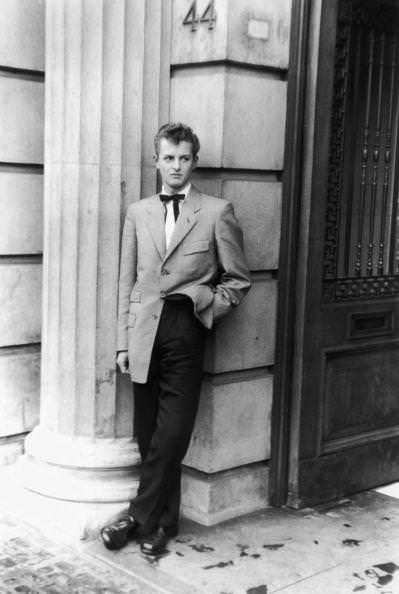
Outside a stone-fronted entrance marked “44,” Alec Cruickshank leans with easy confidence against a column, poised as if he’s just stepped out of the weekday City routine and into Saturday-night London. The doorway beside him—dark, heavy, and patterned—frames the moment like a stage, hinting at the excitement waiting beyond. In his relaxed stance and direct gaze, there’s a sense of a young clerk claiming a sharper, louder identity after office hours.
His outfit speaks the language of early-1950s youth style: a long, pale drape jacket with broad shoulders, narrow dark trousers, and highly polished shoes that catch the light at the pavement. A small bow tie sits neatly at the collar, adding a flash of formality that feels deliberately chosen rather than required. It’s the kind of careful, head-to-toe look associated with the Teddy Boy era—smart, slightly theatrical, and built to be noticed on a dance floor.
Tottenham’s Mecca’s Royal Dance Hall offered exactly that sort of spotlight, where fashion, music, and courtship mixed under bright lights and strict door policies. The contrast between the conservative stone architecture and Cruickshank’s youthful swagger captures a postwar Britain in transition, when a new consumer culture and new attitudes were emerging in the streets. For anyone searching for authentic 1950s London nightlife, Teddy Boy fashion, or British youth culture, this portrait distills the moment just before the evening begins.