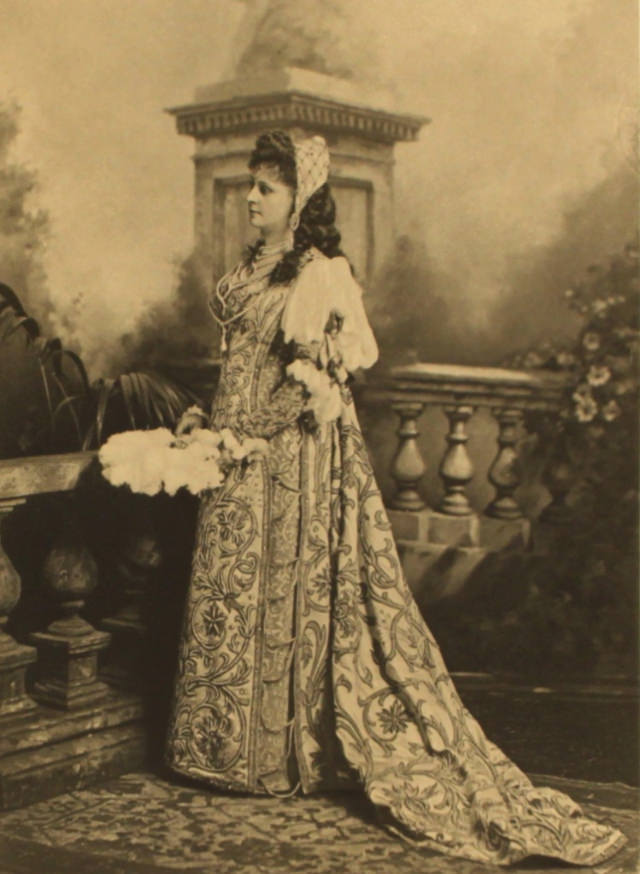
Mrs von Andre appears in profile as Desdemona, poised against a theatrical garden backdrop where a stone balustrade and a distant pedestal lend the scene a stately, almost stage-set grandeur. Her gaze is turned slightly away, giving the portrait a quiet dramatic tension that suits the Shakespearean role. The soft focus and warm tonal range suggest an era when society portraits aimed to feel both intimate and elevated, blending performance with high-fashion display.
Richly patterned fabric dominates the composition, cascading into a long train that pools across the carpeted floor in dense, scrolling motifs. A close-fitting, embellished bodice and layered sleeves emphasize the silhouette, while a small head covering frames her hair and reinforces the historical styling expected of a costume ball interpretation. In her hand, a pale bouquet or floral accessory adds a delicate counterpoint to the heavy textile work, drawing attention to the careful coordination of props, posture, and costume.
Such portraits speak to the late-Victorian fascination with pageantry and literary character, when elite gatherings celebrated culture through elaborate dress and meticulously staged photographs. Rather than simply recording an outfit, the image functions as a visual résumé of taste—textiles, ornament, and theatrical reference woven into one memorable persona. For anyone researching the Devonshire House Ball and its famous fancy-dress tradition, this portrayal of Desdemona offers a vivid window into how fashion, performance, and social identity met before the camera.