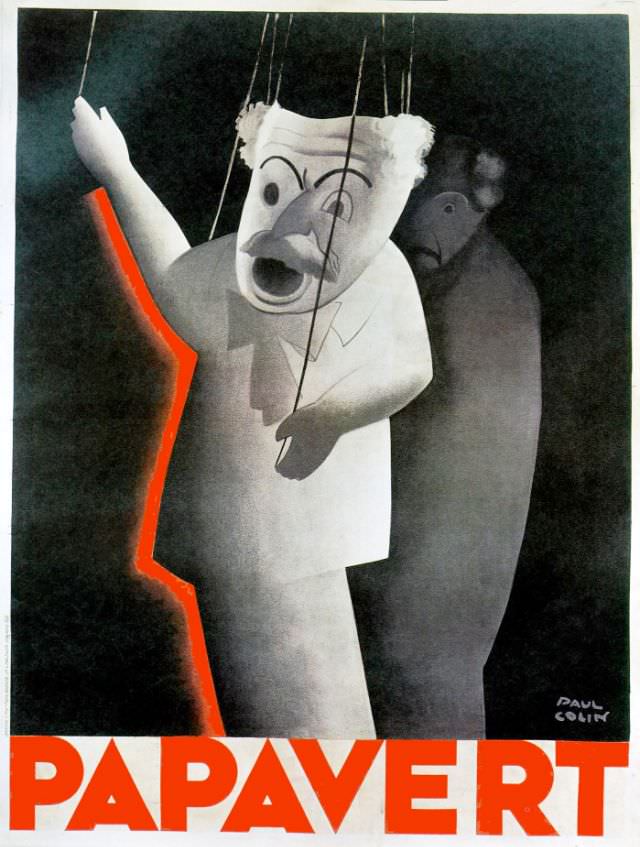
A stark, puppet-like figure lunges out of the darkness, mouth agape as if mid-cry, its strings sharply visible against the black field. A jagged red stroke cuts along the left edge like a flash of danger or a theatrical curtain tear, while a shadowy companion shape looms behind, doubling the sense of unease. At the bottom, the bold typography of “PAPAVERT” anchors the design as unmistakable cover art, built to grab attention from across a lobby or kiosk.
The title, “Théâtre de l’Apollo. Papavert, 1935,” places this piece in the world of interwar stage culture, where modern graphic design increasingly became part of the performance. Here, the poster doesn’t merely advertise; it suggests mood and story—manipulation, spectacle, and the uneasy boundary between actor and marionette. Minimal color, exaggerated expression, and heavy contrasts make it feel cinematic, as if a single frozen moment is hinting at the drama to come.
For readers interested in theatre history, French poster art, or 1930s visual culture, this image offers a compact lesson in how publicity could be both artful and unsettling. The composition’s bold lettering, limited palette, and string-pulled imagery reflect a modern sensibility that still feels striking today. As a historical photo reproduction and graphic artifact, it stands as a memorable doorway into the atmosphere of a night at the Apollo—and the charged promise of “Papavert.”