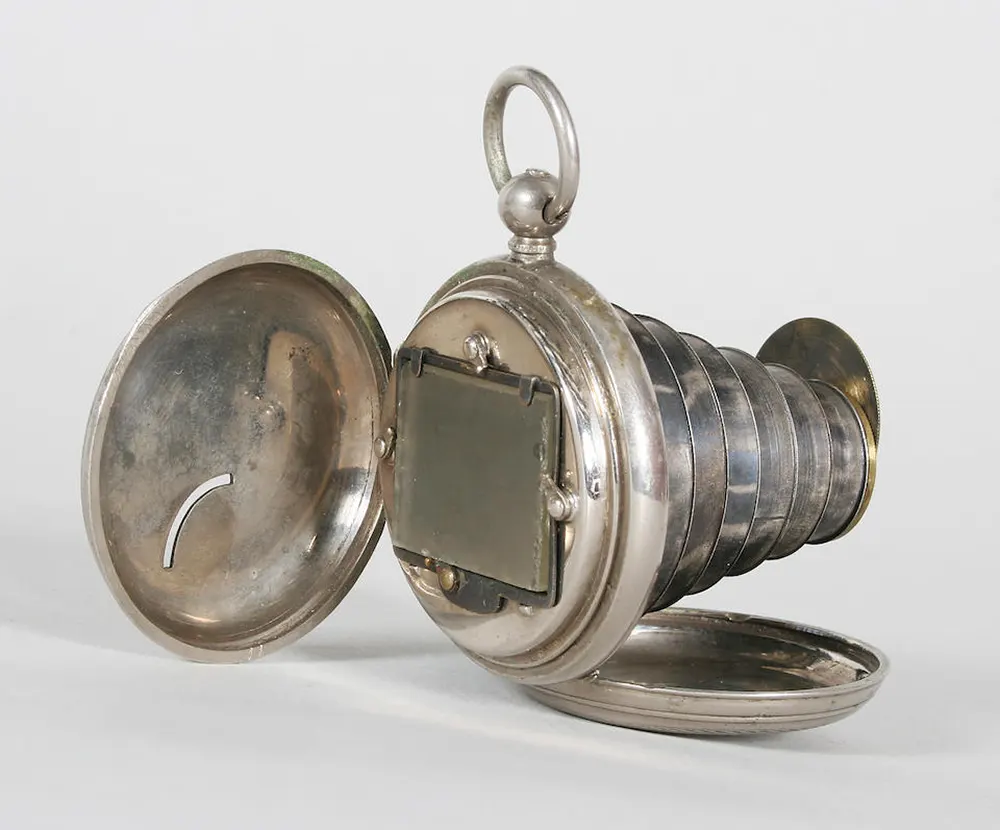
Gleaming like a gentleman’s timepiece yet unfolding into something far stranger, the Lancaster Watch Camera embodies the Victorian appetite for clever concealment. In the photo, the hinged case swings open to reveal a compact mechanism and a collapsible bellows, turning an object meant for the waistcoat pocket into a working photographic instrument. That blend of polished metal, precise fittings, and secret functionality is exactly what made late‑19th‑century inventions feel both luxurious and slightly mischievous.
A closer look at the open lid and ring suggests how easily it could be carried, handled, and—if one wished—used without drawing much attention. The bellows, extended like a miniature accordion, hints at the optical design borrowed from larger cameras, shrunken down to a novelty that still demanded skill and patience. Even without people in the frame, the object tells a story of social change: photography moving from the studio toward everyday life, aided by devices that promised portability and discretion.
Stories of “spy tools” thrive in the popular imagination, and this watch camera earns the reputation simply by its disguise. It sits at the crossroads of horology and early photography, a conversation piece that also reflects real technical ambition—precision engineering serving a new hunger for candid images and private documentation. For collectors, historians, and anyone fascinated by Victorian technology, the 1893 Lancaster Watch Camera remains a striking reminder that ingenious inventions often arrived dressed as ordinary things.