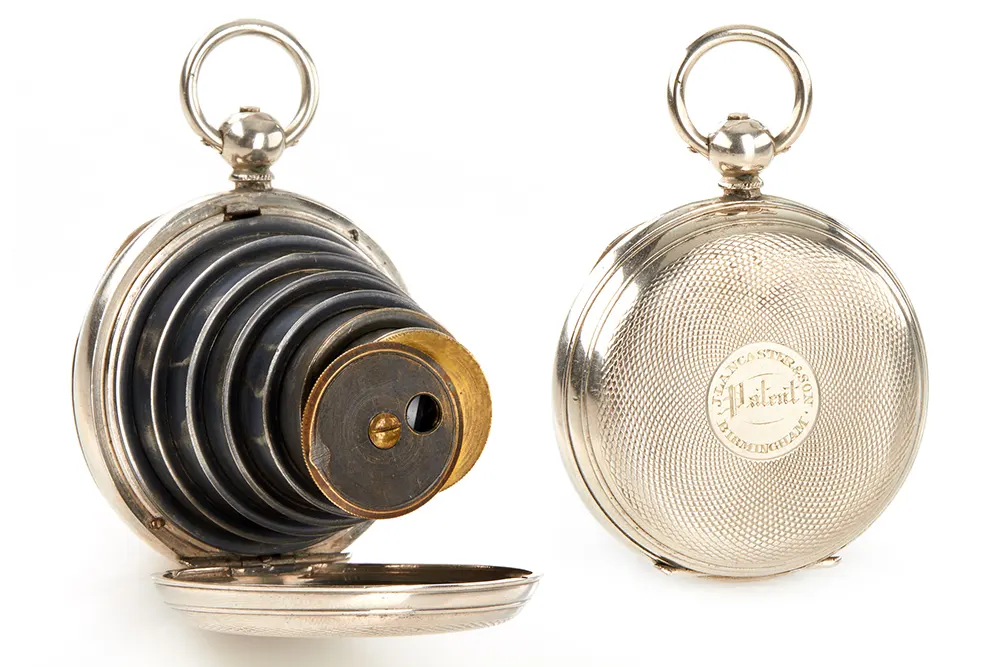
Few Victorian gadgets feel as delightfully paradoxical as the Lancaster Watch Camera: a pocket watch that isn’t a watch at all, but a cleverly disguised photographic instrument. In the photo, the metal case looks convincingly like a timepiece from the outside, complete with a crown and loop, while the opened view reveals a compact camera body tucked within a hinged shell. That contrast—polished “gentleman’s accessory” on one side, functional apparatus on the other—captures the era’s fascination with miniaturization and mechanical surprise.
Swing the case open and the engineering starts to read like a lesson in late‑19th‑century ingenuity. A small lens sits at the end of a short, accordion-style bellows, allowing the camera to extend for focusing while still collapsing into a truly portable form. The textures and finishes matter here: the knurled back, the precise seams, and the stout hinge all suggest an object meant to be handled, pocketed, and carried without drawing attention—exactly the sort of discreet technology that fed Victorian dreams of “spy tools” and candid photography.
Collectors and history buffs alike will recognize why the 1893 Lancaster Watch Camera remains such a sought-after example of early miniature camera design. It sits at the crossroads of personal accessories and emerging visual culture, when photography was becoming more mobile and less confined to studios and tripods. For anyone searching the history of Victorian inventions, hidden cameras, or antique photographic equipment, this tiny marvel offers a tangible reminder that the desire to document life—quietly, quickly, and on the move—has deep roots.