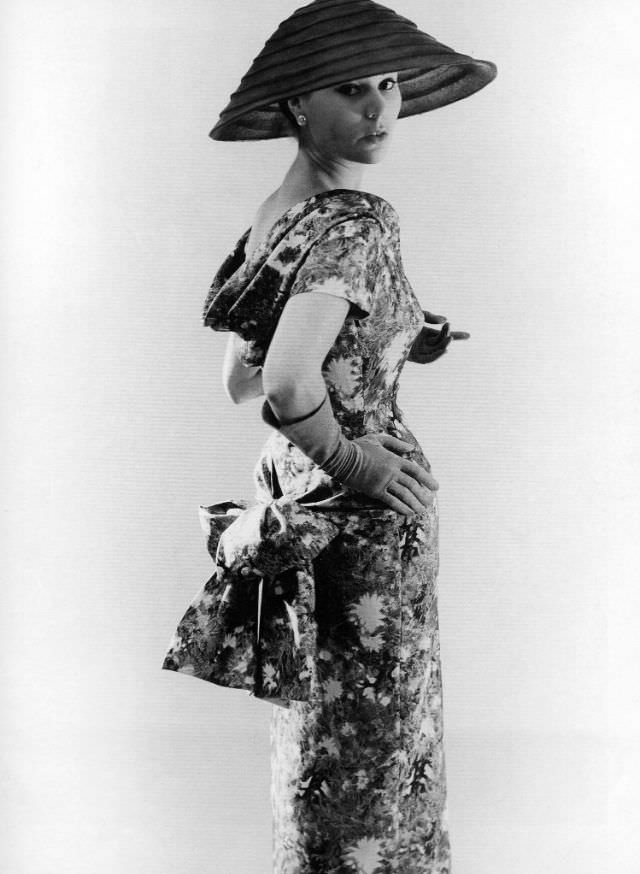
Poised in three-quarter profile, Stella turns her head toward the camera with the cool composure that defined early-1950s fashion imagery. A broad, sculptural hat frames her face and casts a soft shadow, while small earrings and stacked bracelets add a quiet gleam. The restrained studio backdrop keeps every attention on silhouette, posture, and attitude—an elegant balance of mystery and confidence.
Jacques Fath’s cocktail dress brings couture sensibility to an evening look meant for movement and close rooms: a fitted bodice, a tapered line through the hips, and a skirt that seems to catch a breeze at the hem. The floral pattern reads richly even in monochrome, creating texture and depth across the fabric. A trailing bow or draped detail at the back punctuates the design, turning a simple turn of the body into a moment of drama.
Fashion and culture meet here in the way the styling broadcasts mid-century glamour without excess—precise tailoring, strategic accessories, and a pose that suggests both independence and invitation. For readers searching 1953 cocktail dress history, Jacques Fath couture, or classic American modeling aesthetics, the photograph offers a crisp reference point: the era’s obsession with line, polish, and controlled sensuality. Stella’s image, spare yet expressive, hints at the modeling world’s promise of brilliance—made from light, fabric, and an unspoken story.