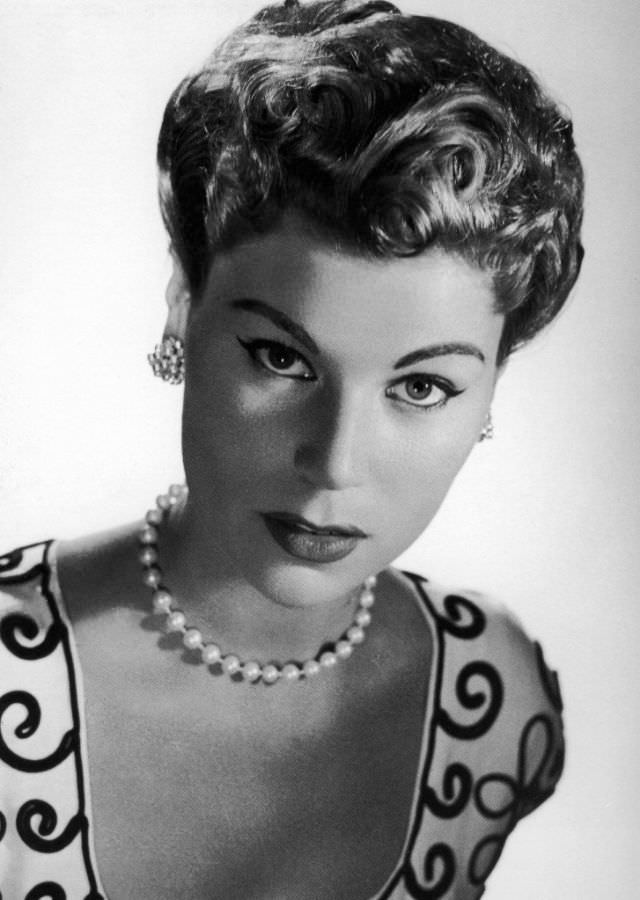
Poised in a tight, luminous close-up, Stella meets the camera with the cool assurance of mid-century high fashion. Her hair is sculpted into glossy waves, arranged with the kind of precision that made salon artistry a cornerstone of 1950s glamour, while bold brows and catlike eyeliner sharpen the symmetry of her gaze. Light falls cleanly across her face, turning the portrait into a study of texture—skin, shadow, and the polished sheen of carefully set curls.
Elizabeth Arden’s hand in hair and make-up is felt in the refined balance: dramatic enough for the runway and editorial pages, yet controlled and elegant rather than theatrical. A single strand of pearls and sparkling earrings frame her neckline, and the patterned garment—swirls and curves against a pale ground—adds a graphic note that reads beautifully in monochrome. Together these details evoke the era’s obsession with immaculate finishing, when cosmetics and coiffure were treated as essential design elements, not afterthoughts.
Set against the title’s world of Jacques Fath, the portrait hints at the international conversation between couture and American modeling culture in 1954. Fashion photography from this period often relied on intimacy rather than spectacle, letting a face carry the narrative of luxury, discipline, and aspiration. For viewers searching vintage fashion history, classic beauty looks, or 1950s couture styling, Stella’s portrait stands as a crisp reminder of how craftsmanship in make-up and hair could define an entire image.