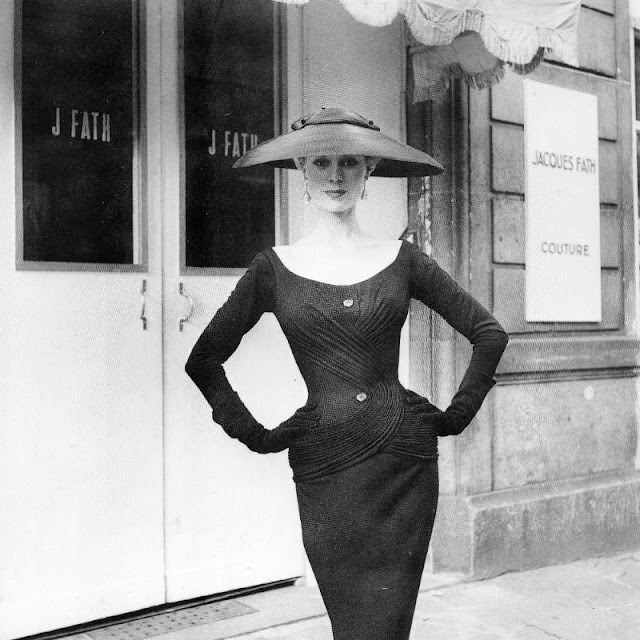
Poised in front of a boutique entrance marked with “J. Fath” and “Jacques Fath Couture,” Stella stands like a walking advertisement for Parisian elegance in Autumn 1954. Her wide-brim hat throws a dramatic shadow across her face, turning the sidewalk into a stage and the doorway behind her into a crisp backdrop of fashion branding. With hands set firmly at her hips, she projects the cool assurance that mid-century modeling prized—controlled, sculptural, and meant to be remembered at a glance.
The black wool jersey afternoon dress is all about line and restraint, hugging the body in a sleek column while subtle, swirling seamwork draws the eye inward to the waist and hips. Two bright buttons punctuate the front like jewelry, a small sparkle against the deep, matte texture of wool. Long sleeves and a low, graceful neckline balance coverage with allure, underscoring the 1950s fascination with a refined silhouette that still celebrated curves.
Beyond the outfit itself, the photograph reads as a slice of fashion culture: couture signage, city pavement, and a model styled to embody the house’s identity. Jacques Fath’s name—visible on the windows and the plaque—anchors the scene in the world of high fashion, where clothing was sold as much through attitude and setting as through fabric and cut. For anyone searching mid-century couture, 1950s street-style elegance, or classic black dress design, this image offers a vivid, era-specific snapshot of how Paris fashion was presented to the world.