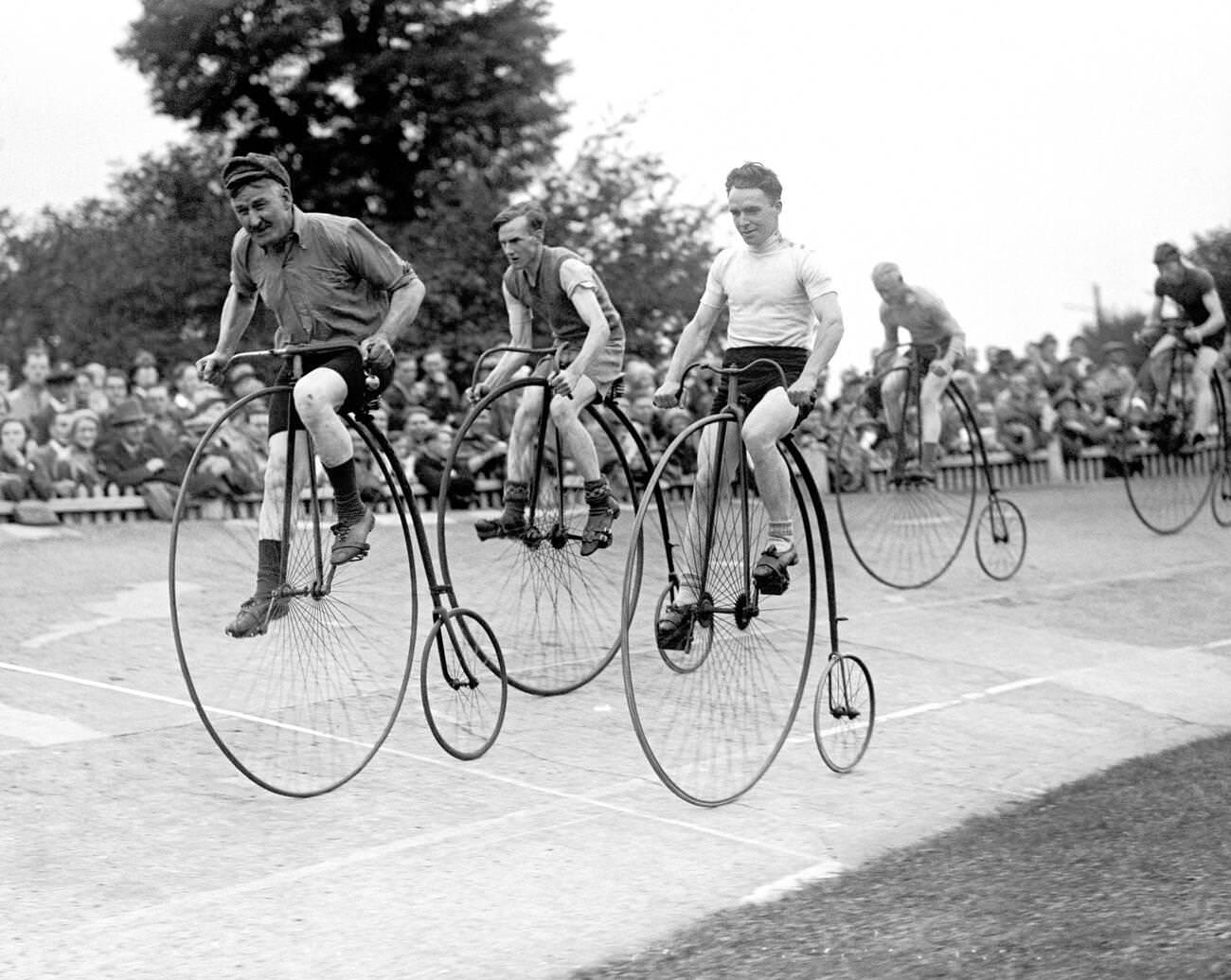
Momentum dominates the scene as a line of riders leans into motion on towering penny-farthing bicycles, their oversized front wheels and tiny rear wheels turning a track into a stage. A dense crowd presses in behind low barriers, suggesting the kind of public fascination early cycling could command, when speed and spectacle were inseparable. Clothing is practical rather than polished—rolled sleeves, knitted tops, sturdy socks—reminding us that athletic identity was still being invented alongside the machines.
The high-wheel design itself tells a story of bold engineering and obvious risk: direct-drive pedals on the big wheel promise pace, but the rider’s perch makes every wobble consequential. Thin tires, spidery spokes, and rigid frames reveal a technology optimized for smooth surfaces and strong legs, not comfort. Seen up close, these bicycles embody the experimental phase of transportation history, when inventors and riders accepted instability as the price of progress.
Contrast is the heart of this post—between eras of cycling technology, between riders’ different styles and physiques, and between the thrilling novelty of early races and the everyday ubiquity of the modern bicycle. For readers searching the history of bicycles, early racing culture, or the evolution from high-wheelers to safer designs, this photograph offers a vivid bridge from invention to sport. It invites a closer look at how a simple idea—two wheels in line—kept transforming until it reshaped mobility, leisure, and competition.