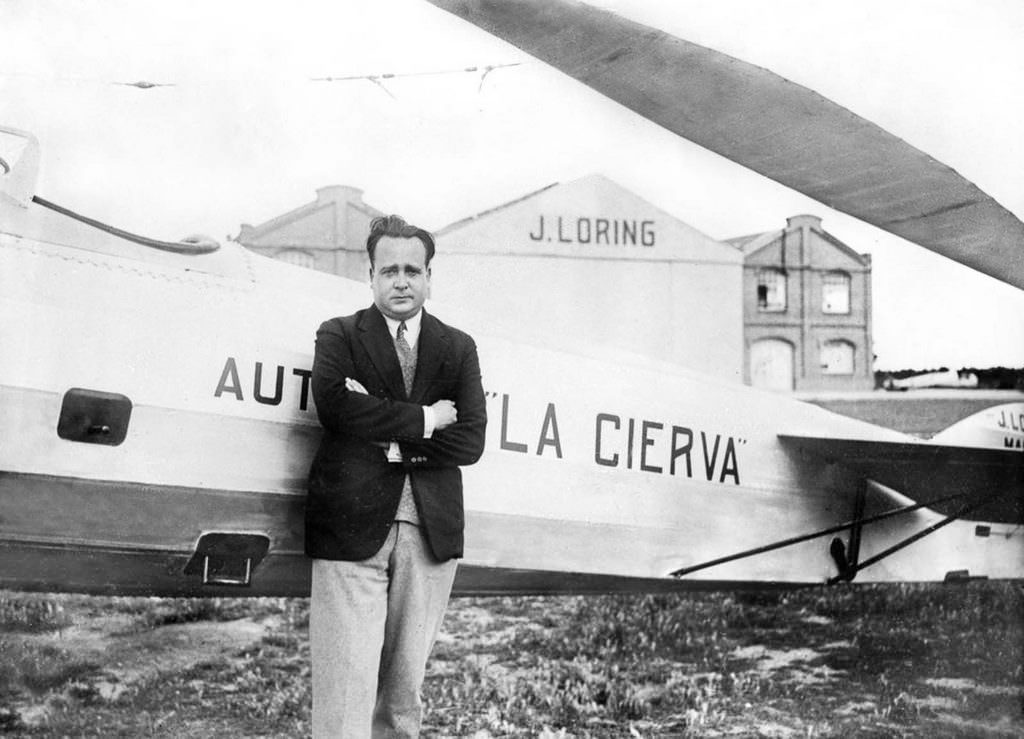
Juan de la Cierva stands with arms folded beside an aircraft bearing the word “AUTOGIRO,” its long rotor blade stretching across the top of the frame like a promise of a new kind of flight. The clean fuselage lettering and the calm, formal pose evoke a moment when aviation was still defining its possibilities, and inventors were becoming public figures through their machines. Behind him, hangars and airfield structures hint at a working test environment rather than a staged studio scene.
In 1929, the autogyro represented a crucial experiment in rotorcraft design, bridging the gap between fixed-wing airplanes and the helicopter era that would follow. Unlike conventional aircraft silhouettes, this craft’s defining feature is the rotor system above the body, a visual cue to the engineering challenge Cierva was tackling: safer low-speed handling and controlled descent. The photograph functions as both portrait and proof, pairing the inventor with the tangible result of his aeronautical research.
For readers interested in early aviation history, this image offers rich details for understanding how “inventions” were demonstrated, branded, and celebrated in the interwar years. The airfield backdrop, the clear markings on the aircraft, and the inventor’s proximity to the machine all reinforce the story of innovation being tested in real space and weather, not just on paper. As a WordPress feature, it’s an evocative snapshot of 1920s aeronautics and the enduring fascination with the autogyro’s role in the evolution of flight.