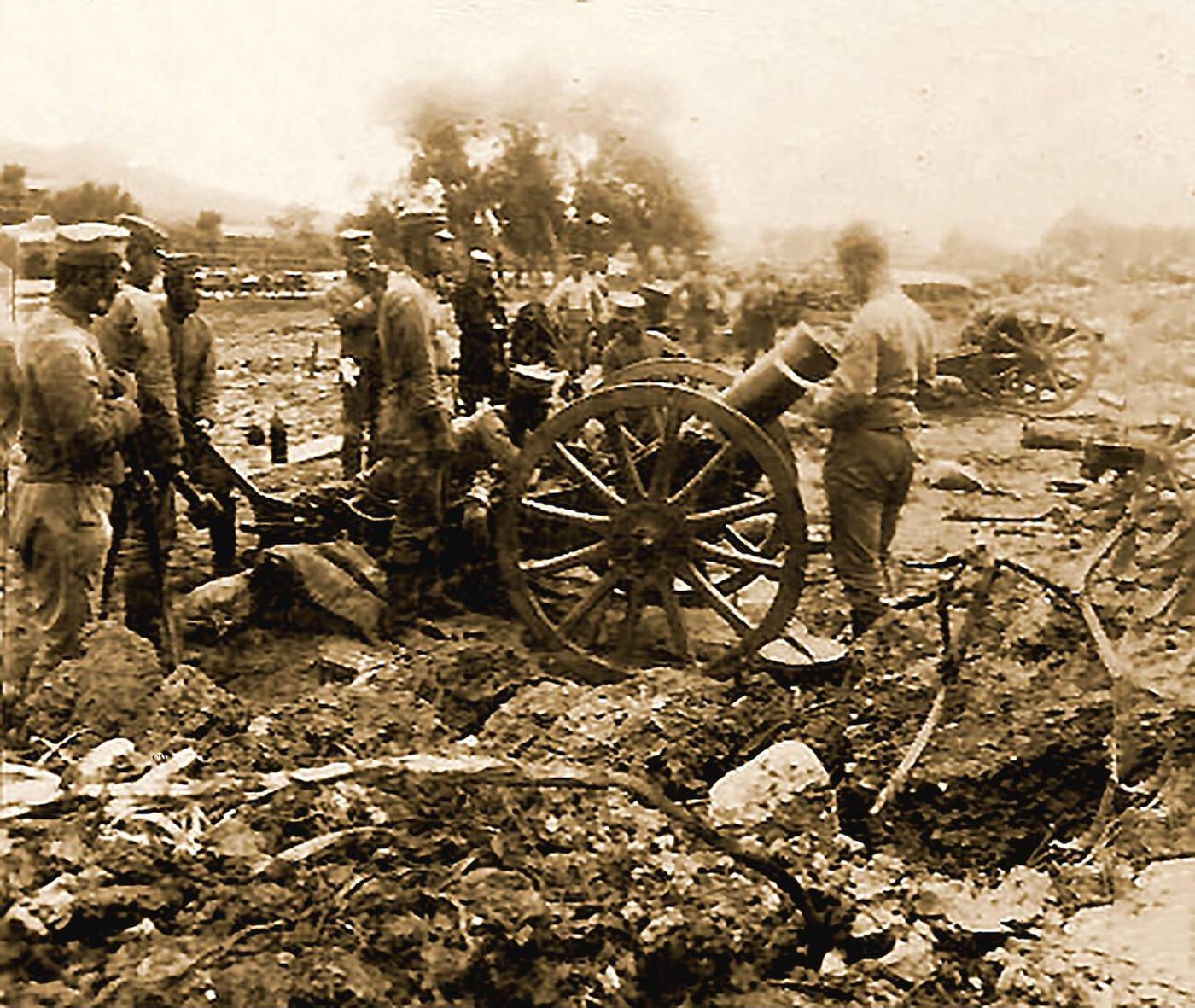
Mud, smoke, and scattered debris set the stage as a Japanese howitzer crew works in the open during the Battle of Shaho in Manchuria, part of the Russo-Japanese War in 1904. The gun’s large spoked wheels and squat barrel dominate the foreground, while soldiers cluster around the position, some standing watch and others tending to the weapon and its immediate needs. In the distance, faint shapes of additional artillery and figures fade into a hazy battlefield atmosphere.
Artillery defined so much of this conflict, and the photograph emphasizes the physical reality behind the headlines: heavy equipment dragged and emplaced on unforgiving ground, ammunition handled by hand, and men exposed to the elements as much as to enemy fire. The earth looks churned and uneven, suggesting sustained bombardment and constant movement, with the landscape itself becoming part of the struggle. Details like uniforms, posture, and the crowded gun line evoke the disciplined routine required to keep such a weapon firing under pressure.
For readers interested in military history, the Russo-Japanese War, or early 20th-century warfare in Manchuria, this scene offers a vivid glimpse of battlefield logistics and frontline endurance. It also hints at the transition toward increasingly industrialized combat, where artillery power and coordination could shape the outcome as decisively as infantry assaults. As a historical photo, it invites a closer look at how the Battle of Shaho was fought—one gun crew, one position, and one smoke-filled horizon at a time.