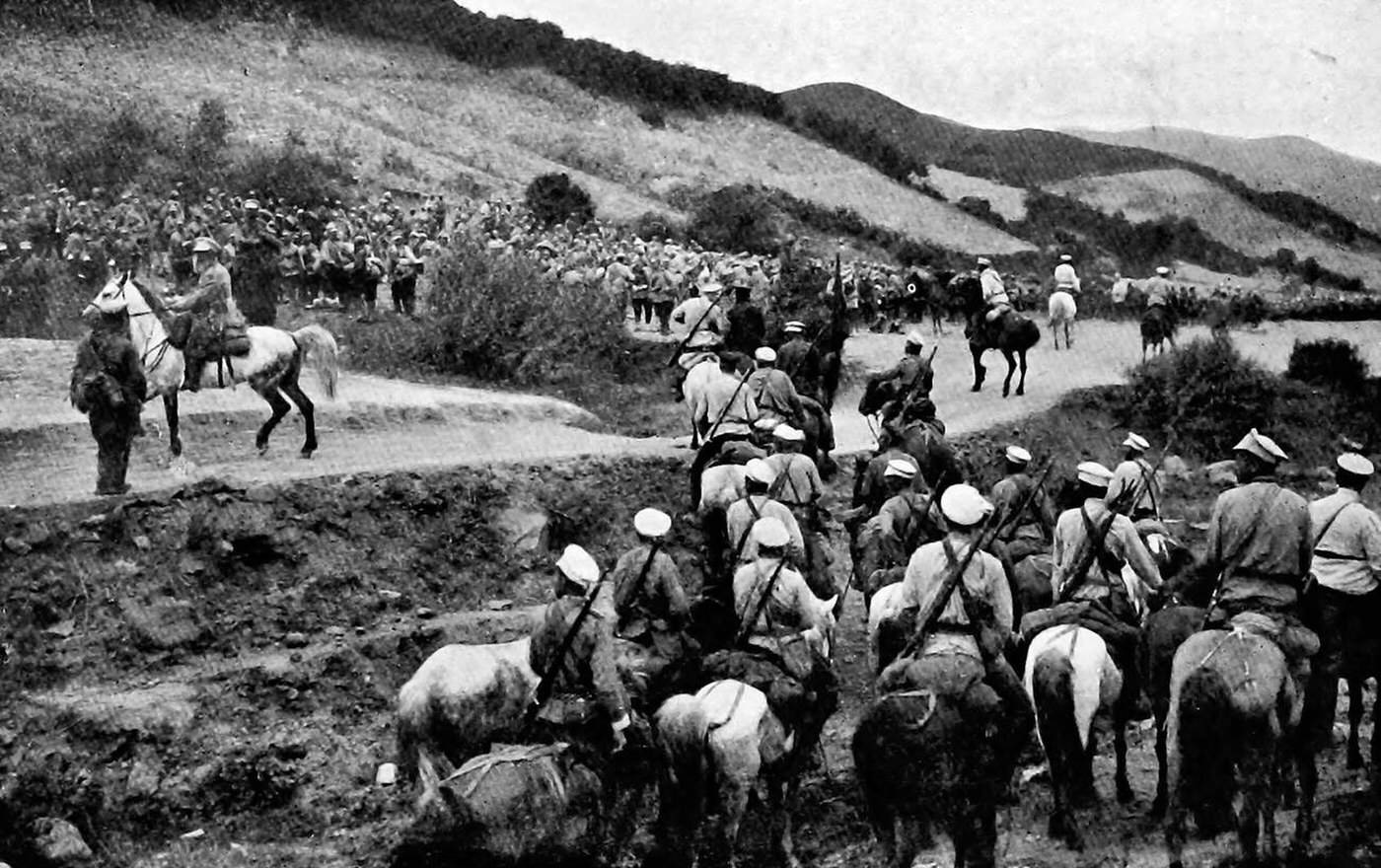
Along a winding mountain road, Russian troops gather in dense ranks as cavalry and infantry funnel toward the heights ahead. White caps and slung rifles form repeating patterns across the frame, while riders on horseback pace the column and help manage the movement of men and kit. The rugged hillside and scrubby vegetation emphasize how much the landscape itself shaped every decision before a fight could even begin.
The Russo-Japanese War was marked by modern firepower meeting older habits of massed maneuver, and scenes like this hint at that uneasy transition. Horses remain essential for scouting and command, yet the sheer number of foot soldiers signals the grinding scale of the campaign. With no explosions or visible enemy, the tension comes from anticipation—an army assembling, waiting for the moment the quiet road gives way to combat.
For readers interested in wars and military history, this photo offers a grounded look at logistics, terrain, and morale rather than battlefield spectacle. The steep ridgelines in the background suggest why “the heights” mattered so much: whoever held them could observe, defend, and dominate the approaches below. As a historical image from the Russo-Japanese War, it invites a closer reading of uniforms, formation, and geography to understand how armies prepared to fight in a changing age.