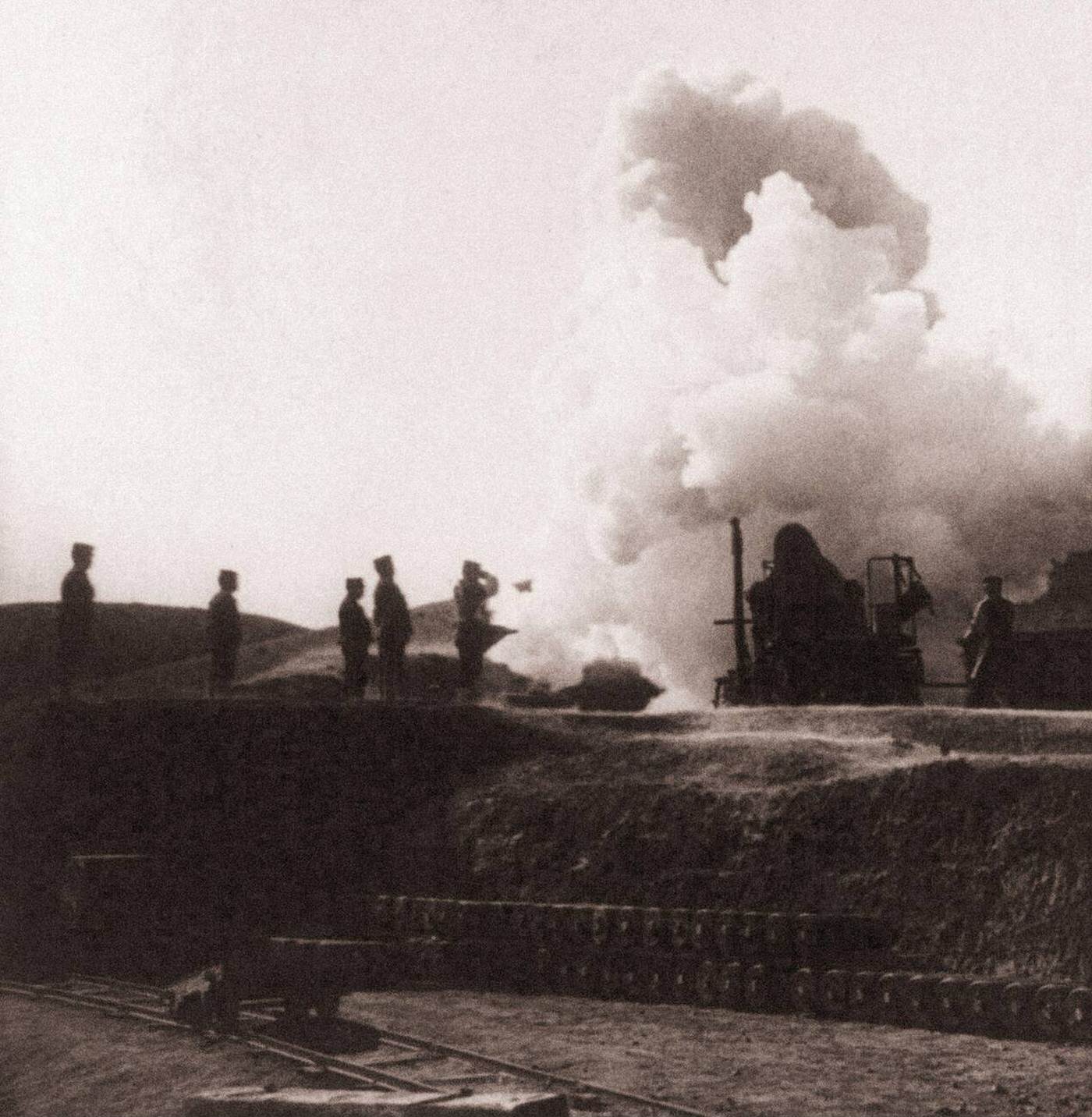
A jagged plume of smoke hangs in the pale sky as a Japanese siege gun recoils on a bare ridge, its crew reduced to dark silhouettes against the blast. The moment is all force and geometry—low earthworks, a heavy mount, and the abrupt bloom of propellant gas marking the instant an enormous 11-inch shell begins its deadly arc toward Port Arthur, China. Even without close-up detail, the scale is felt in the space the gun dominates and the way the men stand back from its violence.
Set during the Russo-Japanese War of the 1900s, the scene speaks to the industrial turn in warfare, when long-range artillery could batter fortifications from miles away and reshape entire campaigns. The rough ground and improvised berms suggest a siege environment, where engineering, logistics, and patience mattered as much as courage. Here, the photograph freezes not the impact, but the dispatch—an early chapter in destruction that would land far beyond the frame.
For readers interested in wars and military history, this image offers more than a dramatic burst of smoke; it is a study in how technology and terrain met on the edges of empire. Port Arthur became a symbol of modern siege warfare, and shots like this one hint at the relentless rhythm of bombardment that defined the struggle. Seen today, the composition invites a sober imagination: the thunder at the gun, the waiting at the target, and the long, unseen flight between them.