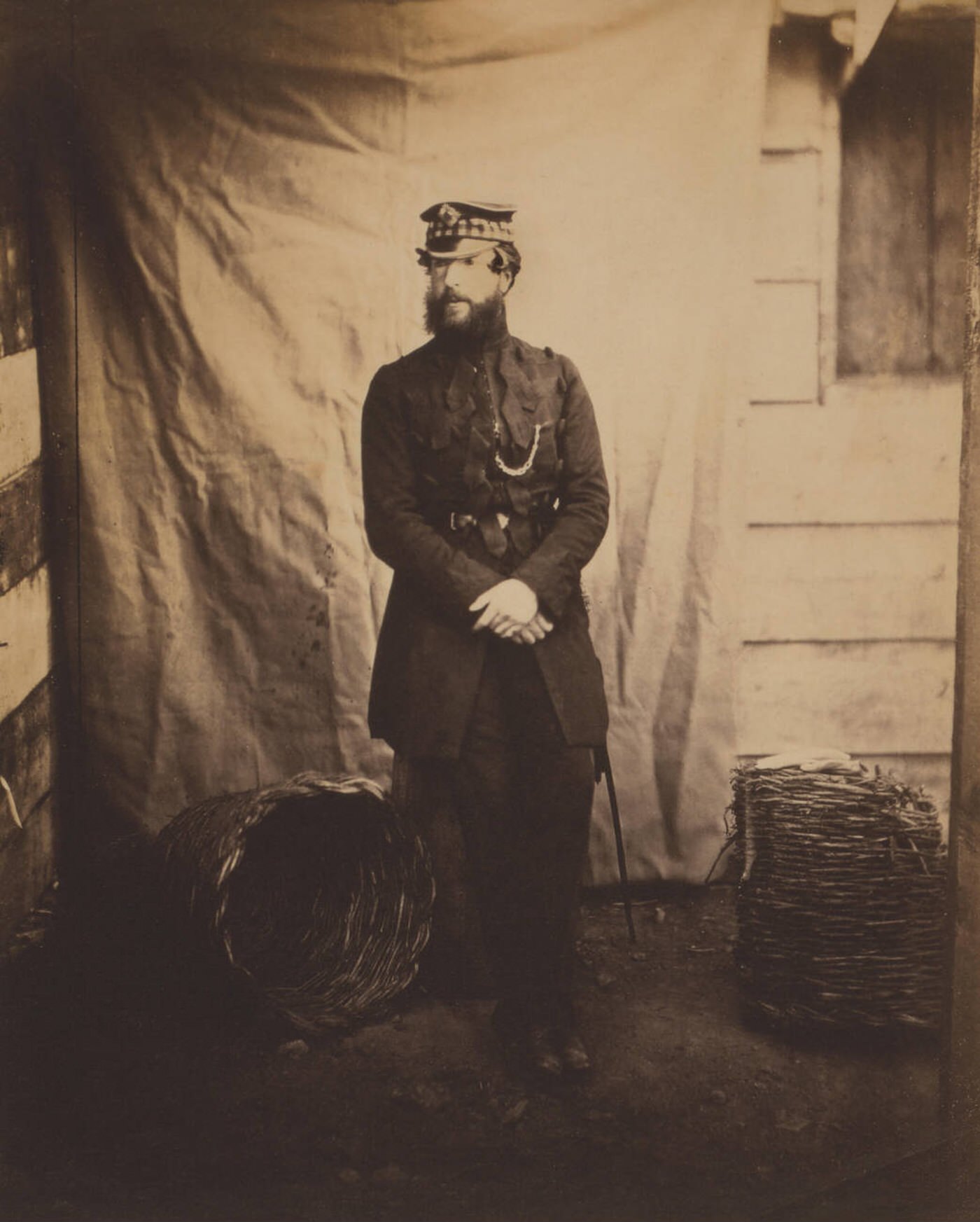
Bearded and composed, British Captain Charles Holder stands for the camera in 1855, his dark military coat neatly fastened and a patterned cap set firmly above a steady gaze turned slightly to the side. A chain drapes across his chest, and his hands rest together in front, giving the portrait a formal calm that contrasts with the conflict implied by the Crimean War context. The soft, sepia-toned exposure and careful posing suggest a deliberate effort to preserve an officer’s likeness amid wartime uncertainty.
Behind him, a simple cloth backdrop hangs in loose folds, while rough wooden boards frame the scene, hinting at a makeshift studio environment rather than a polished metropolitan setting. Coils or bundles stacked at floor level add texture and a faint sense of the logistical world surrounding nineteenth-century campaigns, where supplies and fortifications mattered as much as battlefield maneuver. Even without explicit scenery, the photograph’s spare props and utilitarian setting speak to the era’s practical realities.
Portraits like this help anchor Crimean War history in individual presence, turning broad narratives of strategy and suffering into something more intimate and human. For readers exploring wars and military photography, Captain Holder’s image offers a compelling example of mid-Victorian portraiture and the visual culture of the British Army in the 1850s. It invites closer attention to uniform details, posture, and photographic technique—small clues that deepen our understanding of how servicemen wished to be seen, remembered, and recorded.