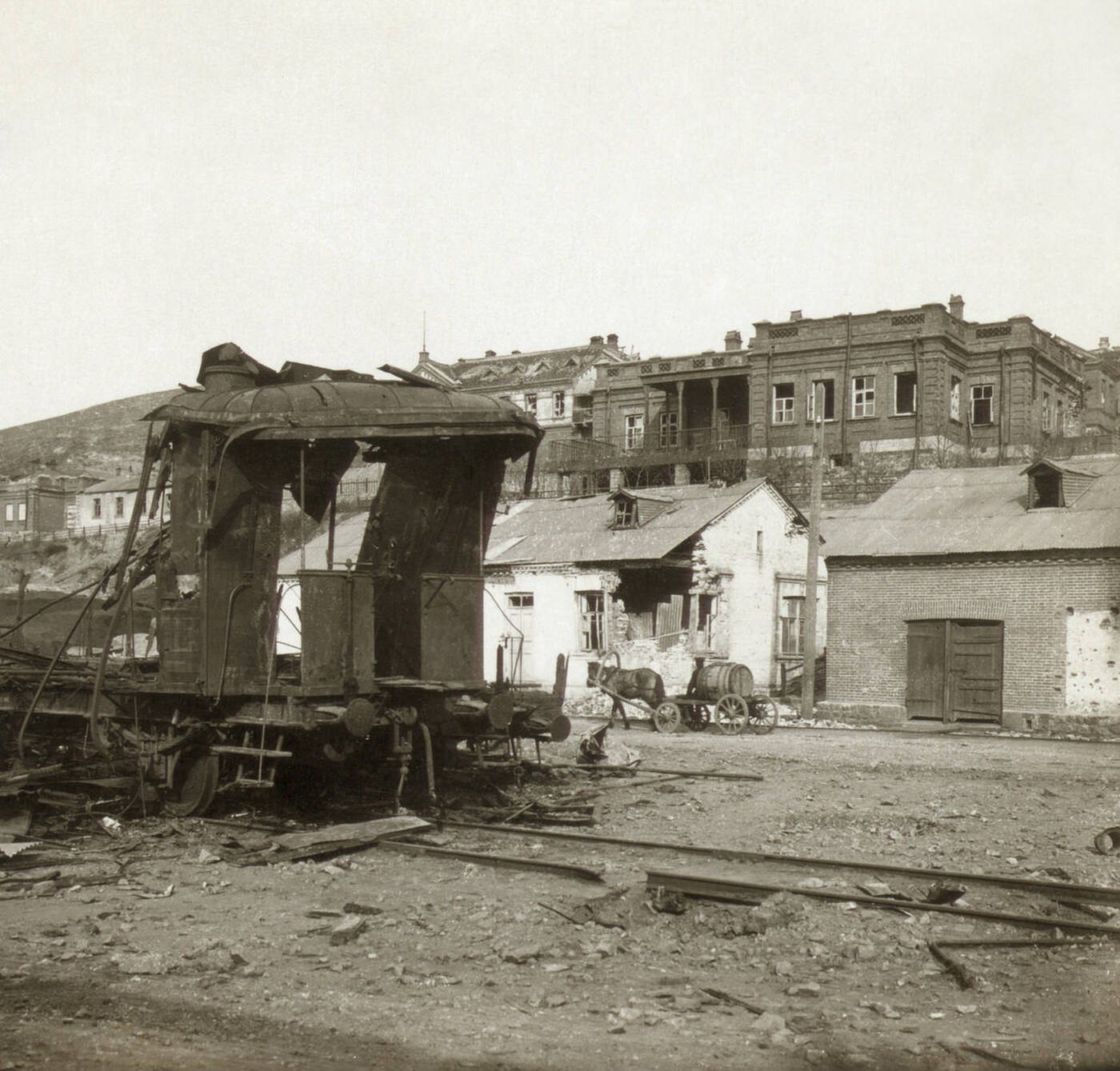
A battered railcar sits twisted on the tracks, its roof peeled back and its sides scorched, as if the metal itself has been forced to remember the blast. Debris litters the rail yard in the foreground, while behind it a row of low buildings shows the quieter, structural wounds of bombardment—broken masonry, shattered windows, and torn rooflines. The title anchors the scene in Port Arthur, China, in 1905, where modern firepower met the infrastructure of a working port city.
In the distance, sturdier multi-storey structures rise above the smaller roofs, their façades pocked and darkened, hinting at repeated shelling rather than a single strike. The contrast between the intact geometry of some walls and the ragged gaps in others makes the damage easier to read: war does not erase a place all at once, it unthreads it. Even the street-level details—scattered timbers, rails that still run forward into emptiness—suggest how commerce and movement were interrupted in an instant.
For readers exploring Wars & Military history, this photograph offers a stark, ground-level view of the siege’s aftermath without the romantic distance of maps or proclamations. It speaks to the logistical heart of conflict: rail lines, storage buildings, and the everyday architecture that becomes collateral when shells fall. As a searchable record of the Port Arthur bombardment in 1905, it invites closer attention to how urban spaces in China were reshaped by the pressures of early twentieth-century warfare.