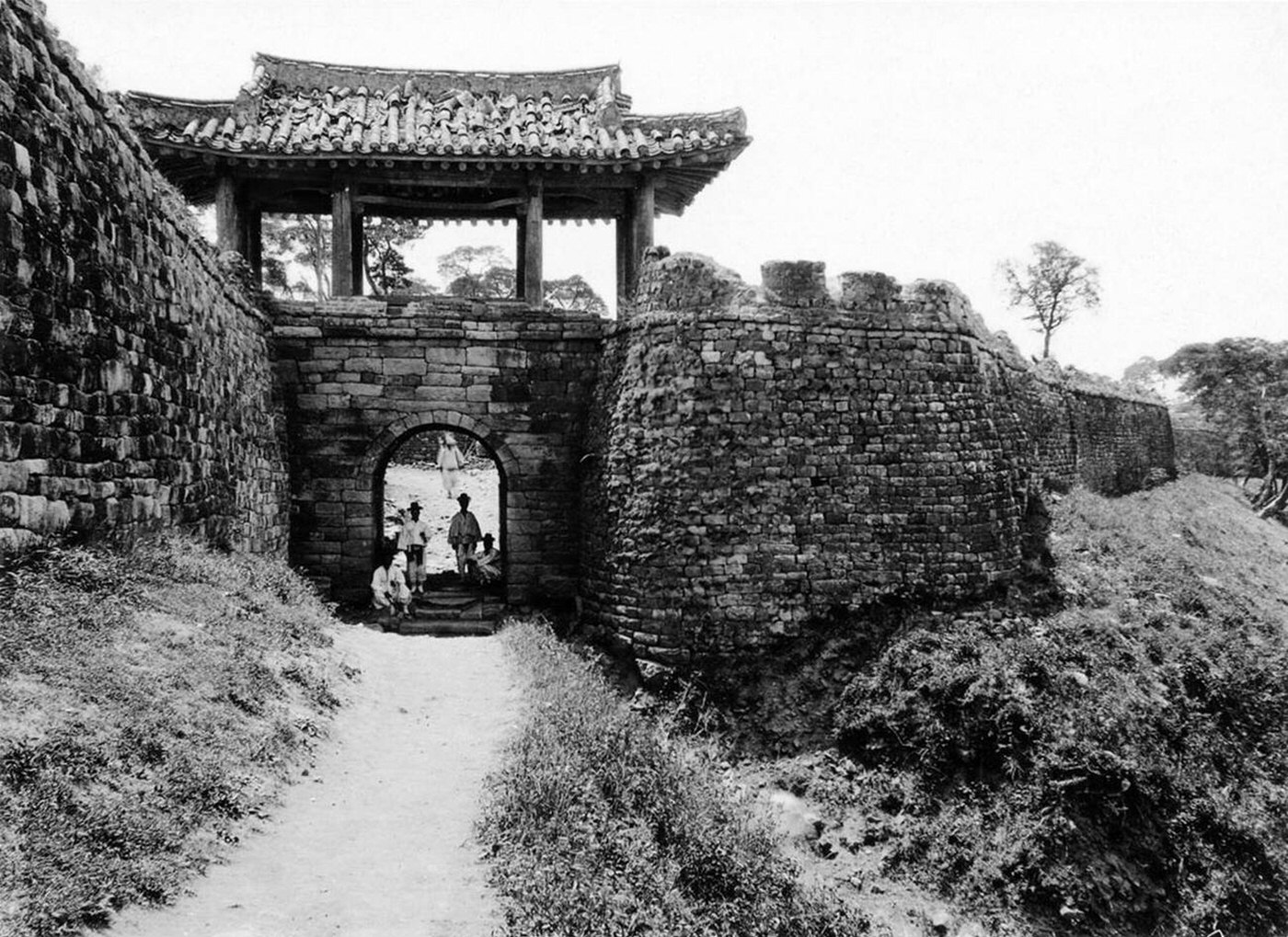
Rising from rough-hewn stonework, the Seven Star Gate in Pyongyang stands with a tiled pavilion perched above a narrow arched passage, its walls curving outward like a bastion built to absorb pressure and time. A dirt path funnels the eye straight to the gateway, where a small cluster of figures gathers in shadow and sunlight, emphasizing the scale and solidity of the fortifications. Sparse trees and uneven ground beyond the masonry hint at the gate’s place on the edge of the city’s defenses, where movement could be watched, counted, and controlled.
In the 1900s, this quiet architectural threshold was remembered for a far louder role: the title links it to the first shots of land fighting at the opening of the Russo-Japanese War. That contrast—peaceful stone and an unassuming roadway against the sudden arrival of modern conflict—gives the photograph its tension. The gate becomes more than a landmark; it reads as a witness to a turning point, when borders and streets in Korea were pulled into the contest between empires.
Details linger for anyone drawn to Korean city walls, early 20th-century Pyongyang, or Russo-Japanese War history: layered brickwork, weathered joints, and the protective geometry of the entrance. The human figures at the arch, tiny against the mass of stone, invite questions about daily routines continuing under the weight of uncertain news. For readers browsing Wars & Military photography, this scene offers an atmospheric, SEO-friendly window into how a familiar urban gateway could suddenly become a stage for the beginnings of a wider war.