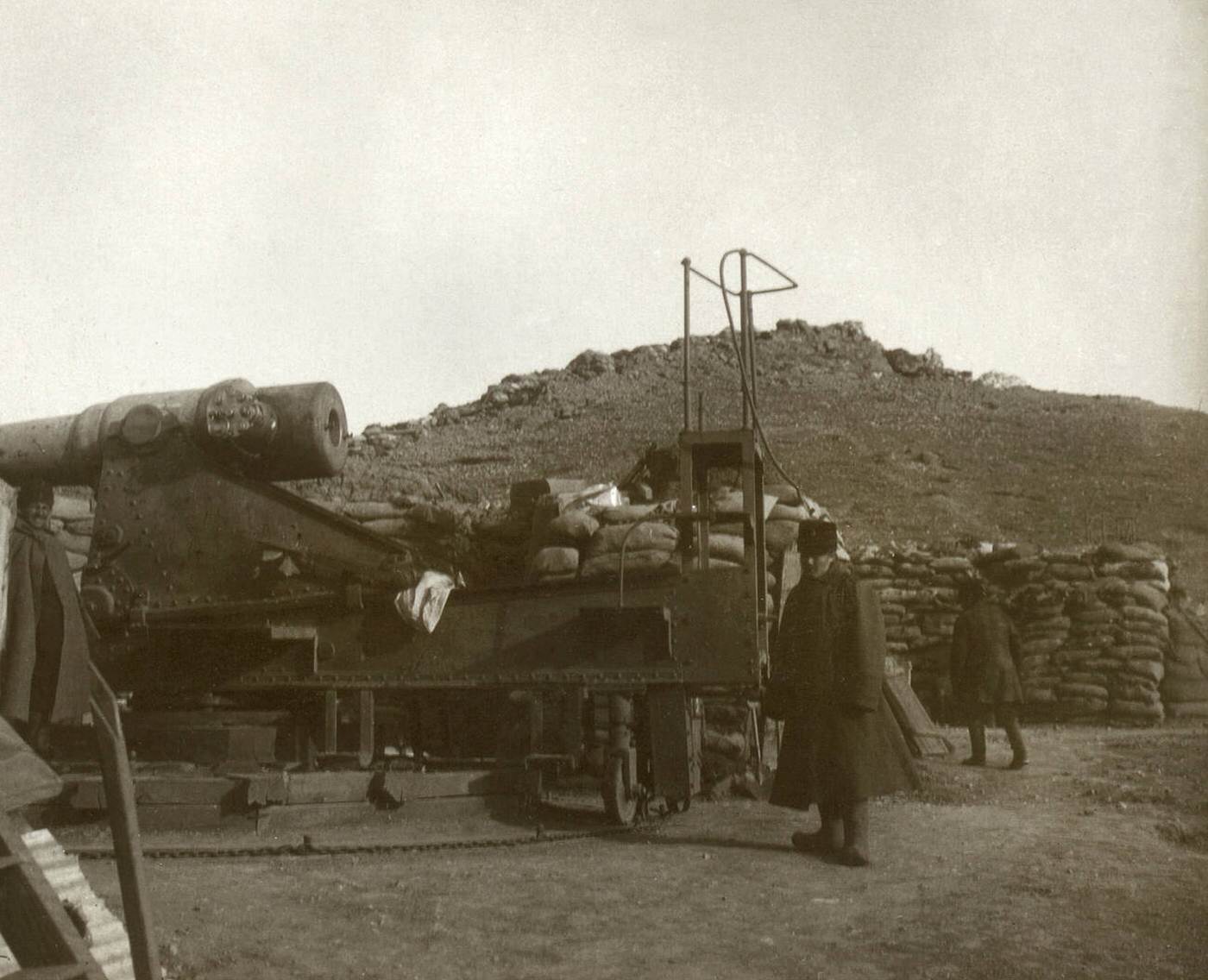
Heavy artillery dominates the foreground, its thick barrel jutting over a low earthwork of sandbags as soldiers in long coats stand watch beside the emplacement. The gun sits on a robust carriage with metal fittings and tracks, suggesting a position prepared for repeated firing rather than a momentary stop. Behind it, a rough hillside rises like a natural rampart, adding to the sense of a fortress landscape stripped down to dirt, stone, and improvised protection.
Port Arthur’s siege was a contest of engineering as much as courage, and the photograph hints at that relentless practicality: stacked sandbags, a cleared firing platform, and equipment arranged for quick handling under pressure. The men appear small next to the cannon’s mass, emphasizing the industrial scale of early twentieth-century warfare and the way defenders relied on fixed guns to command approaches. Even without action in the frame, the posture of the scene—stationary, guarded, and ready—conveys the tense patience of a besieged garrison.
For readers drawn to wars and military history, this image offers a grounded look at Russian defensive artillery during the great siege of Port Arthur in China in 1905. It speaks to the broader story of the Russo-Japanese War era, when fortress guns, trenches, and siege tactics foreshadowed conflicts soon to come. As a historical photo, it invites closer attention to the material details—uniforms, fortifications, and machinery—that shaped life and survival inside an attacked stronghold.