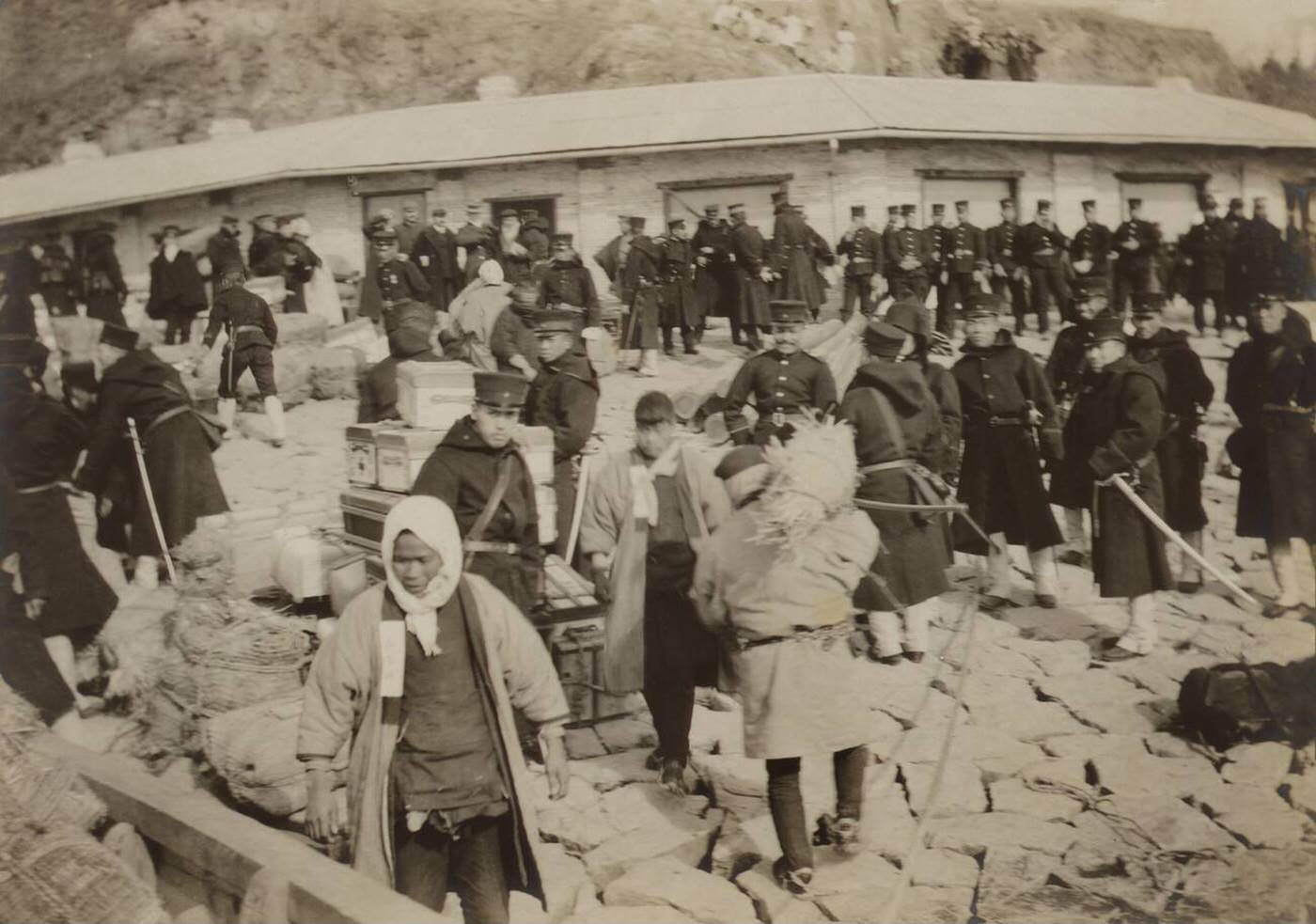
Along the rough stones of the Chemulpo waterfront, uniformed Japanese cavalrymen stand guard as supplies are landed and sorted in the open air. Crates, bundles, and coiled rope crowd the foreground, while a long, low building behind the scene frames a dense line of soldiers watching the work. The composition emphasizes control and vigilance, with weapons slung and bodies positioned to supervise a busy shoreline rather than a battlefield.
In the center and front, labor and military presence overlap: civilians in layered garments move between stacks of freight, carrying loads and navigating the uneven ground. The contrast between dark uniforms and lighter work clothes draws the eye to the practical realities of a campaign—food, equipment, and transport—without which cavalry units could not operate. Even without horses in view, the title’s focus on cavalry hints at a mobile force temporarily anchored to the logistics of the beachhead.
Chemulpo in 1904 evokes the wider tensions of the era and the strategic importance of ports in wartime, where shipping lanes and supply dumps mattered as much as maneuvers. Scenes like this are invaluable for military history, offering a close look at how an occupying or expeditionary force secured materiel, organized manpower, and managed local labor at a crucial coastal node. For readers searching Japanese cavalry, Russo-Japanese War imagery, or early 20th-century Korea’s port life, this photograph provides a grounded, human-scale view of war’s infrastructure.