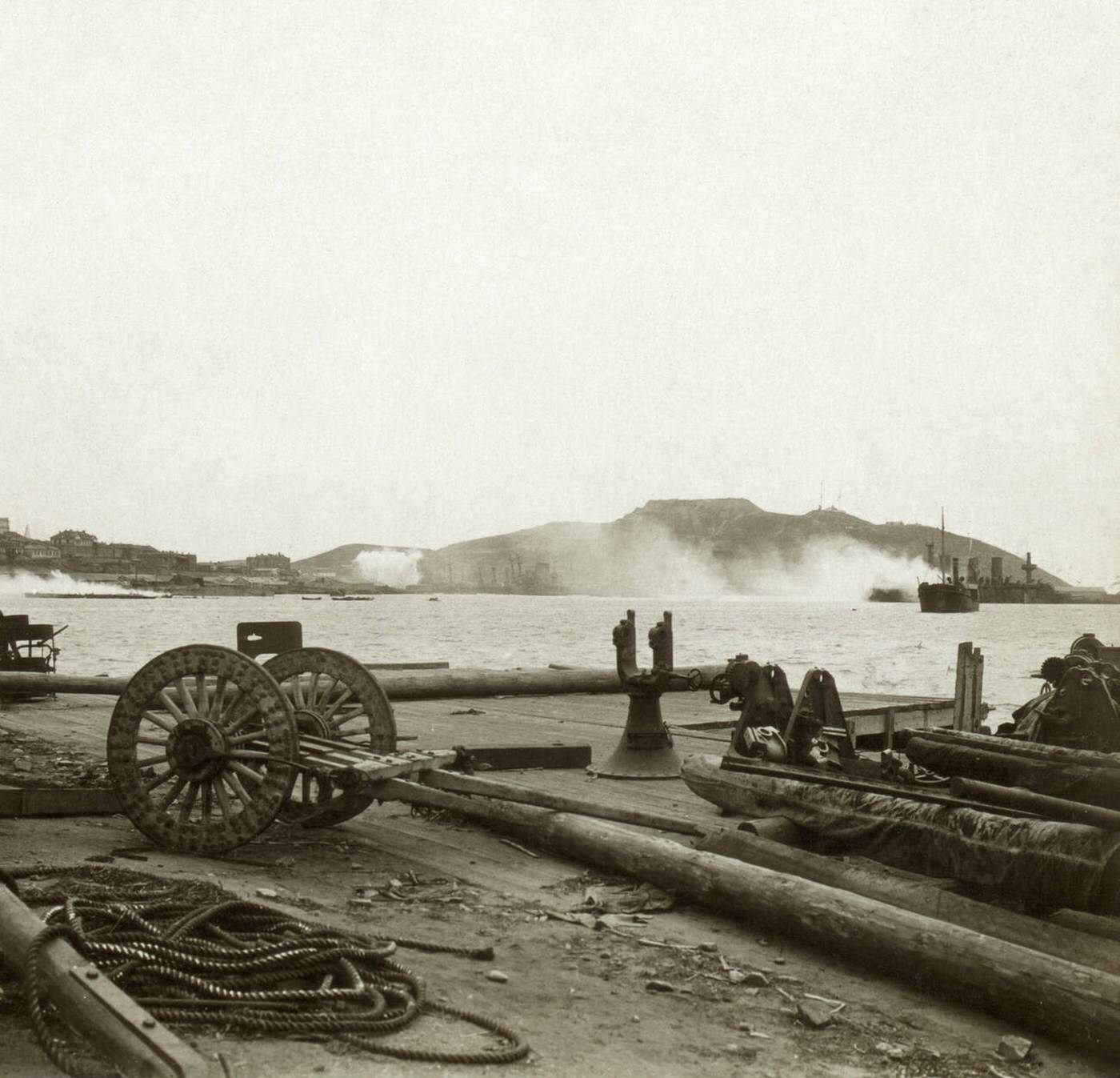
Across the choppy water of the Bay of Lushun (Port Arthur), a low haze hangs where shells have struck or burst, turning the distant shoreline into a blurred band of smoke and hill silhouettes. In the foreground, the scene is anchored by the hard textures of war at sea—coiled rope, rough timbers, and a discarded cartwheel—details that pull the viewer down to dock level as the bombardment plays out beyond. A lone vessel sits to the right, dwarfed by the open bay and the drifting clouds of impact.
Rather than focusing on a single dramatic explosion, the photograph emphasizes the sustained, methodical nature of artillery fire: smoke plumes appear at different points along the waterline, suggesting repeated salvos and careful targeting of ships in harbor. The geography of Port Arthur matters here, with land rising behind the bay and the shoreline shaping where fleets could shelter, maneuver, or be trapped under fire. For anyone searching Japanese artillery bombardment, Russian battleships, or Port Arthur 1905, the image offers an immediate sense of how sea power and coastal positions intersected in this theater.
Taken together, the quiet clutter of the waterfront and the distant violence tell a fuller story than either could alone, capturing how military campaigns press themselves into everyday spaces. The composition invites a slow read: tools and materials of maritime work in front, then the broad water, then smoke and warships at the horizon, as if peacetime industry and wartime destruction occupy the same frame without warning. As a piece of Russo-Japanese War visual history, it serves as both documentation and atmosphere—an unvarnished look at bombardment in the Bay of Lushun at the height of conflict.