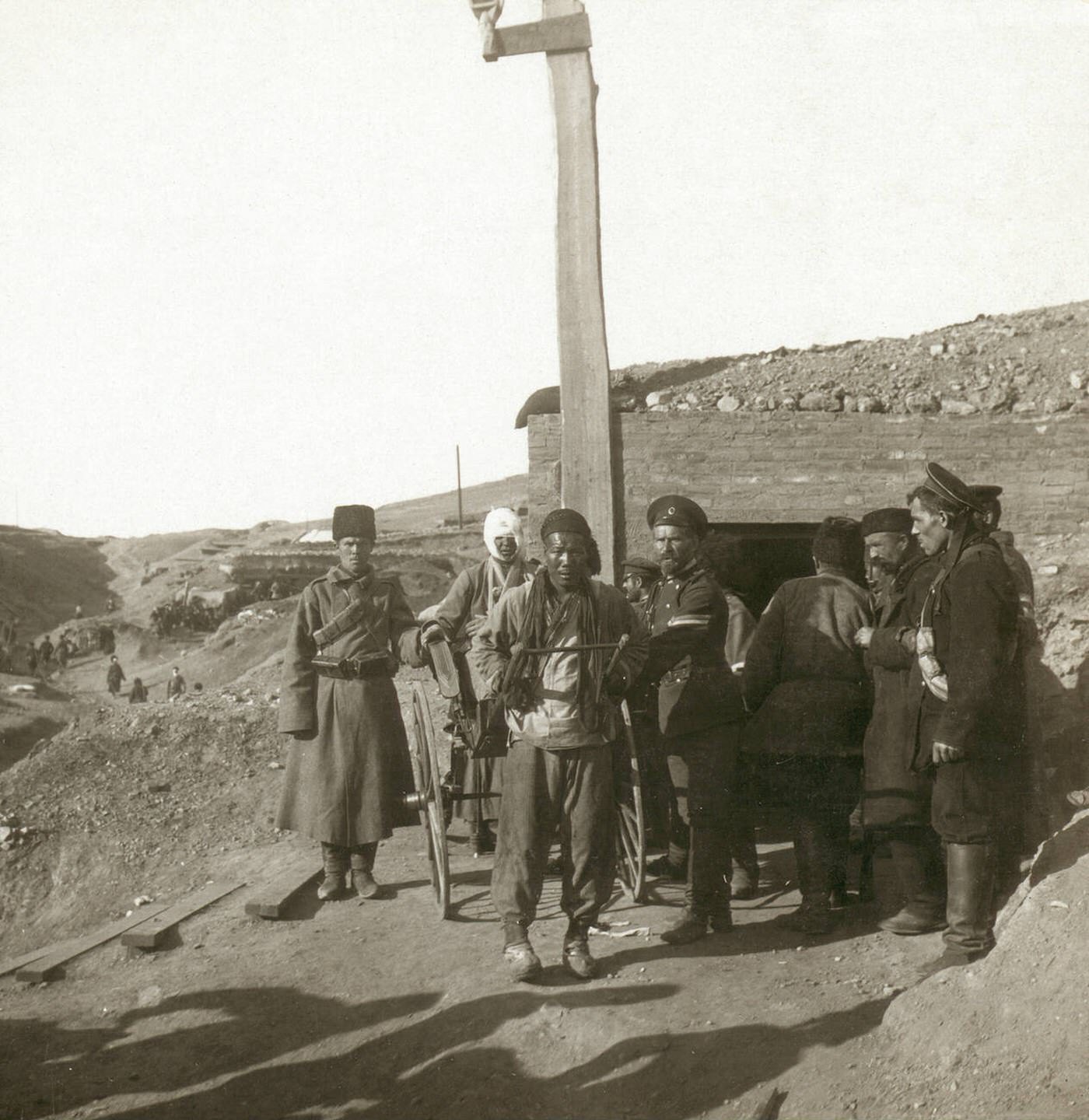
Dusty roads and improvised fortifications frame a tense moment in Port Arthur, where a wounded Russian soldier is being moved from the front toward a hospital in 1905. At the center stands a rickshaw puller, harnessed to a two-wheeled cart while uniformed men cluster around, their heavy coats and caps suggesting a cold, hard campaign. The stark landscape and rough earthworks in the background hint at how close military life and medical necessity sat side by side during wartime.
Along the rickshaw’s narrow track, the scene reads like a snapshot of logistics under strain: a patient too injured to walk, a civilian vehicle pressed into service, and soldiers overseeing the transfer. The pulled cart becomes a bridge between battlefield and treatment, emphasizing how evacuation often depended on whatever transport could navigate broken ground. Even without visible blood or dramatics, the posture and attention of those gathered convey urgency, fatigue, and routine familiarity with suffering.
Port Arthur, China—so central to the Russo-Japanese War—appears here not as a headline, but as a lived environment where endurance mattered as much as strategy. Details like the rickshaw’s simple construction, the layered uniforms, and the improvised pathways make this historical photo valuable for readers interested in military history, wartime medicine, and everyday life behind the lines. It’s a reminder that in 1905 the journey to a hospital could be as perilous and uncertain as the fighting itself.