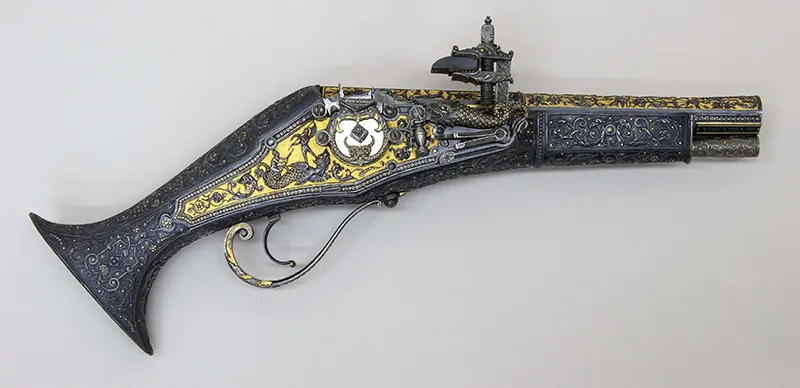
Commissioned for Maximilian I of Bavaria around 1600, this wheellock pistol sits at the intersection of courtly display and cutting-edge engineering. The weapon’s elegant, forward-sweeping butt and finely worked surfaces make it as much a status object as a tool, reflecting the tastes of a European elite that prized artistry alongside utility. For readers interested in early modern arms and “inventions” that changed warfare and hunting, the piece offers a vivid glimpse into what precision craftsmanship looked like at the dawn of the 17th century.
Gold-toned inlays and scrolling ornamentation draw the eye along the stock, while the compact lockwork near the top hints at the pistol’s real innovation. Unlike simpler ignition systems, a wheellock uses a spring-driven wheel to strike sparks, allowing a shooter to fire without managing a smoldering match. That self-contained mechanism demanded skilled metalwork and careful fitting, which is why surviving examples often feel closer to jewelry and clockmaking than to mass-produced weaponry.
Seen today, the pistol reads as a document of ambition: technological sophistication packaged in lavish decoration for a powerful patron. Details such as the layered engraving and contrasting materials underline how early firearms could function as diplomatic gifts, collectibles, or symbols of rank as much as practical sidearms. Whether you’re researching Maximilian I of Bavaria, exploring historic firearms, or tracking the evolution of ignition technology, this image highlights a moment when innovation and prestige were literally built into the same object.