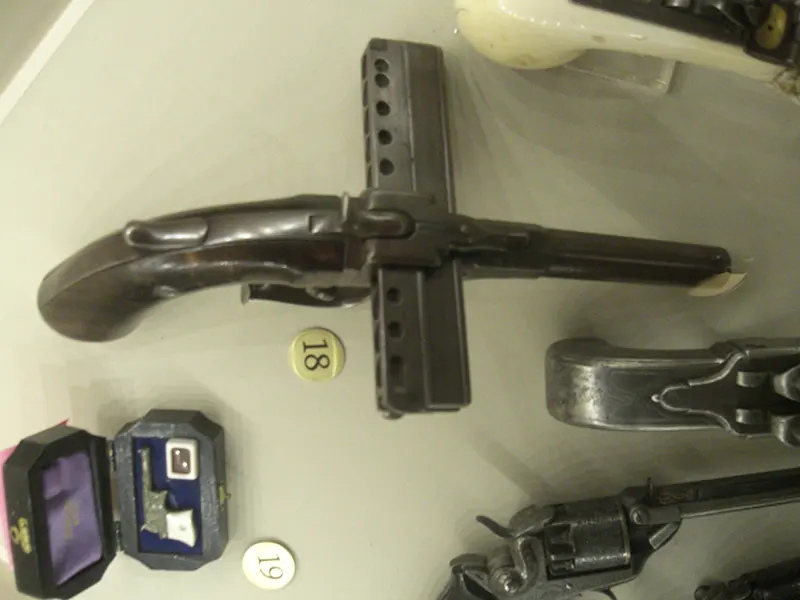
Few objects convey the restless ingenuity of the 18th century quite like the so‑called “harmonica gun,” a firearm that trades a single fixed chamber for a sliding, multi‑chambered magazine. In the photo, the pistol’s compact grip and straightforward barrel are paired with a distinctive rectangular block—punched with openings—set above the frame. That block is the hallmark of the design, hinting at an early attempt to increase a shooter’s ready shots without the slow ritual of reloading after every discharge.
Instead of a revolving cylinder, this system relies on a linear “harmonica” action: the chambered block shifts sideways so a fresh charge can align with the barrel. It’s an inventive solution from an era when gunmakers experimented boldly with repeating mechanisms, often blending practical needs with mechanical curiosity. Even from this angled view, the contrast between the smooth, traditional pistol profile and the angular magazine assembly highlights the transitional nature of the technology.
Museum-style display details—numbered markers and neighboring pistols—underscore that this piece is best understood as part of a broader story of firearms innovation. For collectors, historians, and anyone researching early repeating guns, the harmonica gun offers a fascinating glimpse into how 18th‑century designers tried to solve the problem of sustained fire long before modern cartridges and magazines became standard. The result is a weapon that feels both familiar and strangely experimental, a snapshot of invention in motion.