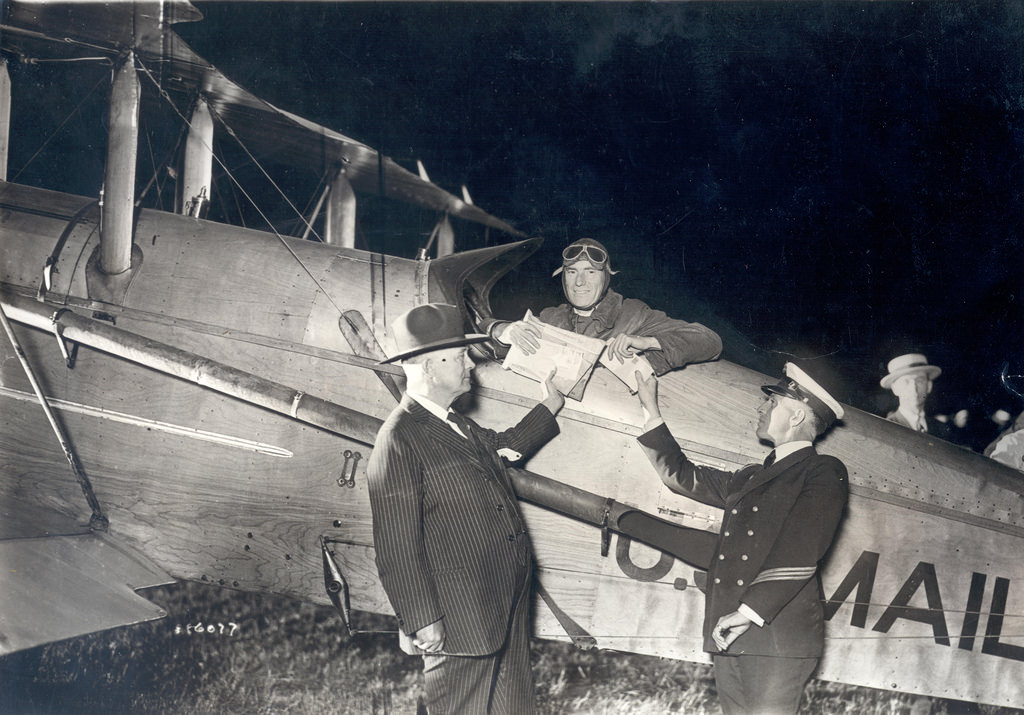
Under harsh night lighting, a biplane marked “MAIL” sits ready while airmail pilot James Hill leans from the cockpit, goggles pushed up, accepting a bundle of letters from uniformed hands below. The scene feels brisk and procedural—paperwork passed up, signatures likely exchanged—yet it carries the charge of risk that came with early aviation after dark. Every visible detail, from the taut wing struts to the open cockpit, underscores how exposed these pilots were as they kept the mail moving.
July 1, 1925 places this moment in the era when transcontinental night flying was transforming postal service from a daylight gamble into a round‑the‑clock network. Night operations demanded more than courage: reliable navigation aids, better lighting on the ground, and disciplined routines that turned an airfield into an assembly line for speed. The photograph captures that intersection of invention and habit—technology enabling a schedule, and a schedule pushing technology forward.
Looking closely, the men on the ground appear as important as the pilot in the air, a reminder that early airmail was a coordinated relay of labor and machinery. The crisp uniforms and the careful handoff suggest accountability, with the mail treated as mission-critical cargo rather than mere baggage. For readers interested in airmail history, early flight technology, and the beginnings of dependable coast‑to‑coast service, this image offers a vivid snapshot of how modern connectivity was built—one night departure at a time.