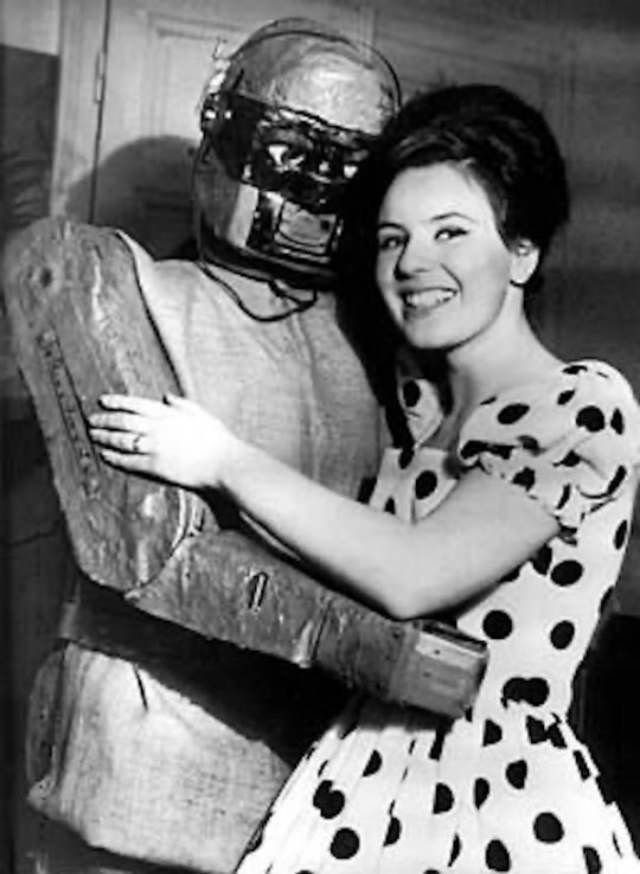
Claus Scholz-Nauendorff’s MM7 Selektor Robot arrives with the theatrical flair of mid-century invention culture, where domestic technology was sold as both marvel and companion. A helmeted, human-sized figure stands stiffly in a simple interior, its visor-like faceplate reflecting the era’s fascination with futuristic materials and machine “personalities.” The title’s promise of revolutionizing housework frames the scene as more than a curiosity: it’s an early glimpse of automation entering everyday life.
Beside the robot, a smiling woman in a polka-dot dress leans in as if introducing a new household helper, turning a technical prototype into a friendly presence. The contrast is striking—soft fabric and patterned fashion against a bulky, industrial-looking body—suggesting how inventors and promoters tried to bridge the gap between cold machinery and warm domestic routines. Even without visible controls or tools, the pose reads like a demonstration meant to reassure, entertain, and spark imagination.
Long before smart homes and robotic vacuums, concepts like the MM7 Selektor Robot hinted at a future where repetitive chores might be delegated to machines. The photograph works as a piece of invention history and a snapshot of cultural optimism, capturing how “robot housework” was marketed through spectacle as much as engineering. For readers exploring retro robotics, household automation, and vintage inventions, this image offers a vivid reminder that the dream of labor-saving helpers has deep roots.