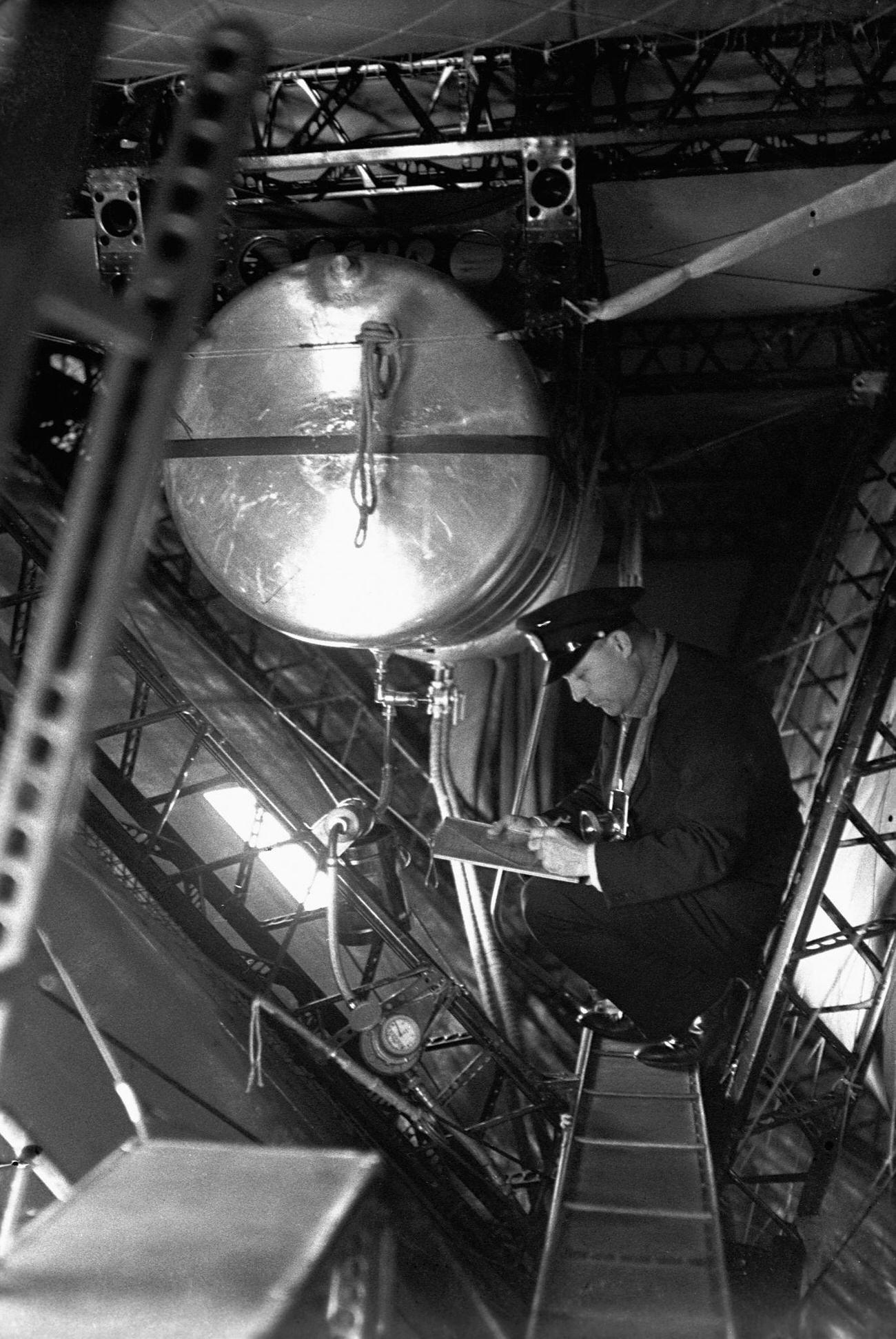
High above the passenger spaces, a uniformed crewman balances on a narrow catwalk inside the Hindenburg, head bent over a notebook as he records readings in a maze of metal ribs and tension wires. The airship’s interior looks less like a luxurious liner and more like an industrial skeleton, where every strut, cable, and fitting has a purpose. A large, reflective cylindrical tank dominates the scene, with valves and lines feeding into the surrounding framework, suggesting the careful management of onboard systems.
Details like the ladder-like walkway, the pressure gauge tucked below, and the cramped working posture hint at the routine labor that kept a giant zeppelin functioning. The man’s notes evoke the daily discipline of inspection—monitoring, adjusting, documenting—tasks rarely celebrated in popular accounts of airship travel. Inventions are often remembered for their bold silhouettes, yet images like this reveal the hidden engineering and constant vigilance required behind the scenes.
For readers interested in aviation history, the Hindenburg is frequently reduced to its tragic end, but this photograph points to the broader story of interwar-era innovation and the technical culture that surrounded rigid airships. The stark contrast of light on metal surfaces emphasizes the scale of the craft and the delicacy of its internal architecture. As a historical photo for a WordPress post, it offers strong visual keywords—Hindenburg airship interior, zeppelin engineering, crew at work, and early flight technology—while inviting a closer look at how these airborne giants were actually operated.