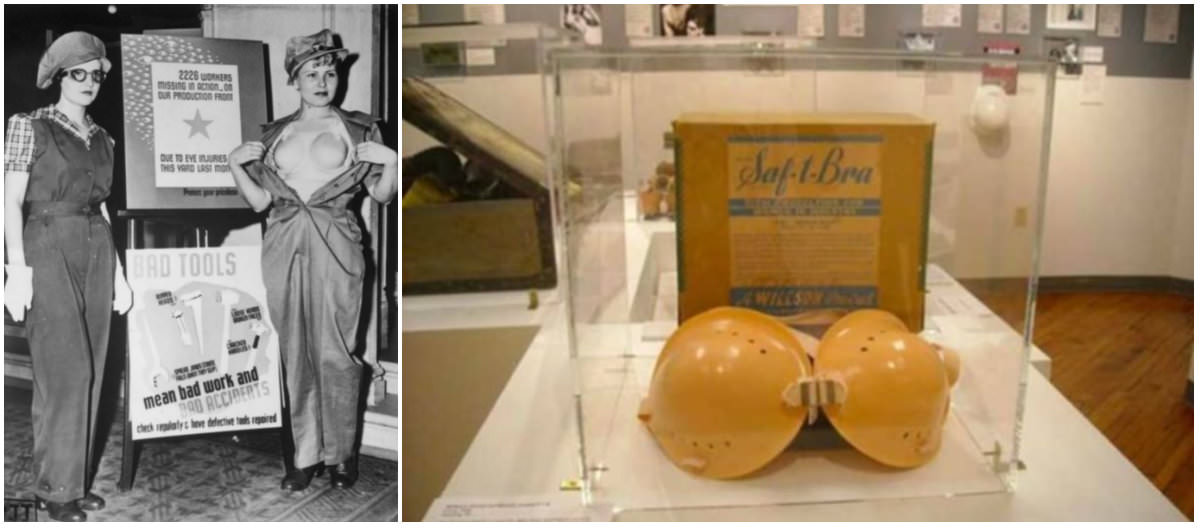
Factory-floor “inventions” weren’t always about faster machines; sometimes they targeted the worker’s body, comfort, and supposedly even safety. In the left-hand scene, two women in workwear pose beside a workplace display that warns about “bad tools,” while one model dramatically opens her coveralls to reveal a rigid, molded undergarment. The staging feels like a training poster come to life—part practical demonstration, part publicity—hinting at how industrial management and manufacturers tried to standardize everything, right down to what employees wore underneath.
Across the paired images, the object becomes clearer: a hard plastic bra, shaped like two domes and punctured with small ventilation holes, presented as a product rather than a private garment. Seen in a display case alongside its box, it reads like an artifact of mid-century consumer engineering—promising durability, easy cleaning, and a kind of modern efficiency that fabric lingerie supposedly lacked. The design’s glossy surface and utilitarian form underline the era’s faith in plastics as the wonder material that could be molded into solutions for nearly any problem.
Yet the title “Plastic Bra for female factory workers” also invites tougher questions about whose needs defined “innovation.” Was it meant to protect against bumps and workplace hazards, to prevent fabric snags around machinery, or simply to impose a particular silhouette under uniforms? However it was marketed, the photo offers a vivid glimpse into gendered industrial history, where women’s labor and women’s bodies were both sites for experimentation—and where the language of safety and progress often doubled as a sales pitch.