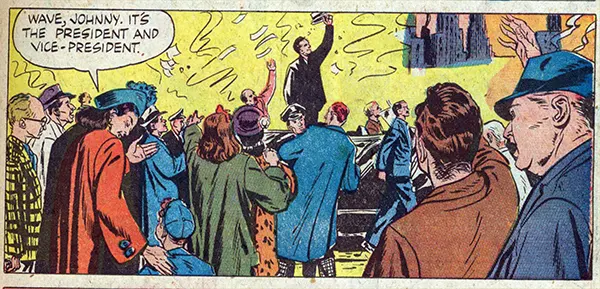
A street crowd cranes forward as a motorcade glides past, hands raised in greeting and faces turned toward a suited figure waving from an open car. One speech bubble urges, “Wave, Johnny, it’s the President and Vice-President,” anchoring the scene in the language of civic spectacle and everyday patriotism. The bright, mid-century comic-book palette and dramatic composition pull the viewer into a public moment that feels both familiar and carefully staged.
Yet the title, “Is This Tomorrow: America Under Communism!”, casts that cheer as something more uneasy—an illustrated warning shaped by 1947 America’s communist fears. The panel’s energy comes from contrast: a celebratory procession on the surface, and a sense of impending threat implied by the wider narrative these artworks belong to. It’s propaganda art in the form of popular entertainment, using accessible visuals to translate political anxiety into a story that could be read at the kitchen table.
For WordPress readers exploring Cold War history, anti-communist propaganda, and vintage comic art, this piece offers a vivid snapshot of how ideology was packaged for mass consumption. The crowd, the car, and the authoritative wave become symbols in a larger argument about power and persuasion—less about documenting an event than about shaping the audience’s imagination of what could happen next. As an example of 1940s American political comics, it invites close looking: at clothing and gestures, at the rhetoric of the captions, and at how fear can be made to feel like common sense.