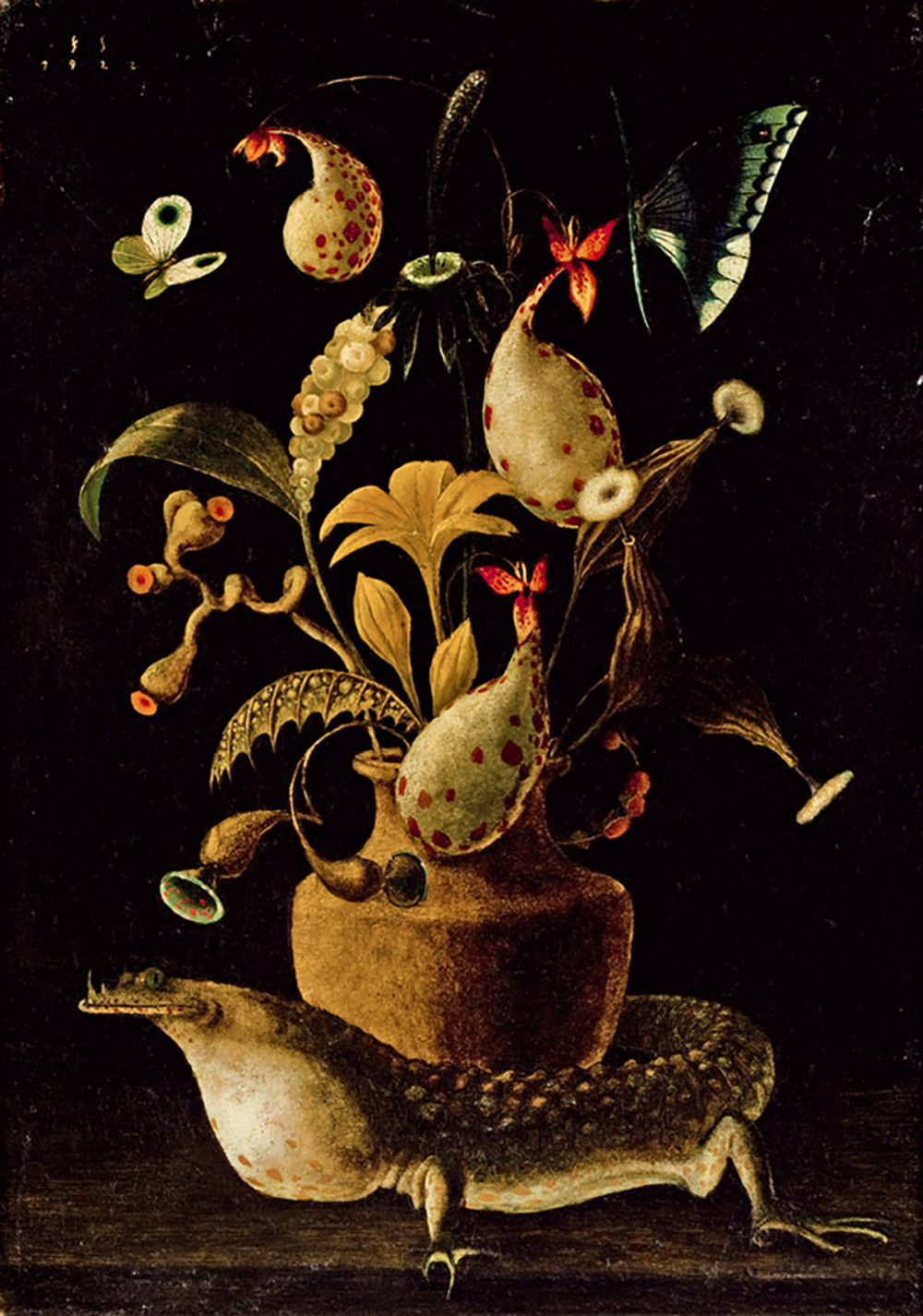
Against a deep, nearly velvety black ground, “Flower Piece, 1922” unfolds like a nocturnal cabinet of curiosities: a vase-like form rises from the back of a crocodile, and from it springs an improbable bouquet of tendrils, pods, and blossoms. Speckled, gourd-shaped blooms curl outward, while a pale, lily-like flower opens at center, its petals lit as if by a spotlight. The still-life tradition is present, yet it’s been playfully unsettled, turning a familiar genre into something closer to a dream.
Color does much of the storytelling here—muted ochres and greens hover beside punctuations of red, and the darkness behind them intensifies every edge and stipple. Butterflies drift around the arrangement, their wings rendered with crisp patterning that contrasts with the softer, almost velour textures of leaves and stems. Look closely and the composition feels engineered to keep the eye moving: arcs echo arcs, and small circular forms repeat like a visual rhyme across the bouquet.
In the broader context of early 20th-century art, the piece reads as a surreal still life that blends natural history, decorative design, and a hint of the uncanny. The crocodile base turns the “vase of flowers” into a living pedestal, suggesting both wonder and unease—beauty rooted in something ancient and feral. For anyone searching for a 1920s artwork that merges botanical fantasy with meticulous detail, “Flower Piece, 1922” offers an arresting, SEO-friendly highlight for collections exploring surrealism, modern still life, and imaginative nature studies.