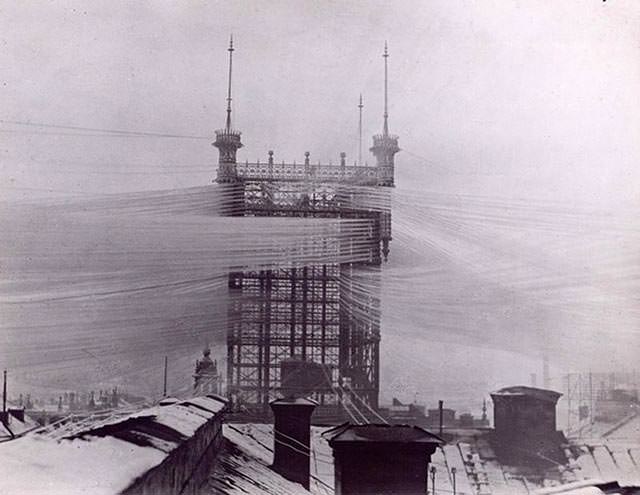
Rising above Stockholm’s rooftops, Telefontornet looks less like a simple tower and more like a mechanical spider at the center of a vast web. Hundreds of telephone wires stream outward in every direction, turning the sky into a dense lattice and hinting at the scale of coordination required to keep the city connected. The stark contrast between the heavy, practical framework and the delicate-looking lines makes the whole scene feel both industrial and strangely elegant.
In 1890, this structure represented a new kind of urban infrastructure: communication made visible. The title’s claim—over 5,000 telephone lines—helps explain the almost unbelievable tangle of cables, each one carrying voices and business across neighborhoods that had previously depended on messengers and mail. Telefontornet wasn’t just a landmark; it was a physical reminder that modern life was beginning to move at the speed of electricity.
Details in the foreground—chimneys, sloping roofs, and wintery surfaces—ground the image in everyday Stockholm while the wire fan above suggests a city reaching outward. For readers interested in the history of telephony, Swedish technology, or the evolution of cityscapes, this photo offers a vivid snapshot of how the late 19th century literally rewired urban space. It’s easy to see why Telefontornet became one of Stockholm’s most memorable symbols of the early telephone age.