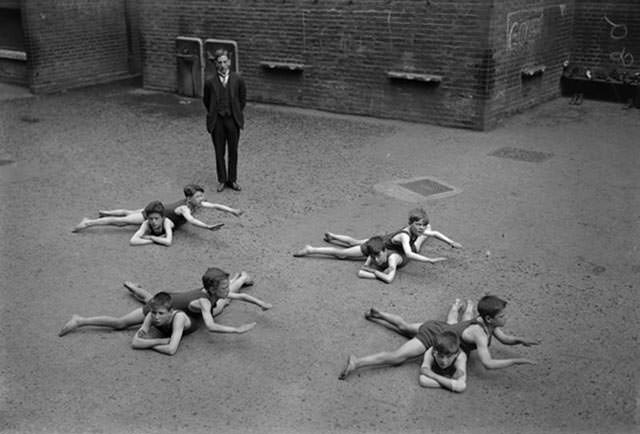
On a bare schoolyard surface, a group of children lie stretched out in their swimwear, arms and legs angled as if they’re cutting through water that isn’t there. An adult in a dark suit stands watch near the brick wall, the contrast between formal authority and improvised play making the scene instantly memorable. Even without a pool in sight, the pose-by-pose discipline suggests a real lesson rather than simple fooling around.
The title’s irony—learning to swim despite a lack of access to water—points to the practical challenges many communities faced in the early 1920s, when facilities could be scarce and public recreation unevenly available. What looks funny at first becomes a small record of adaptation: “dry land swimming” drills that trained breathing, stroke rhythm, and body position using nothing more than pavement and determination. The courtyard’s starkness, framed by brick and hard ground, underscores how creative instruction had to be when resources were limited.
As a historical photo, it offers a vivid glimpse into school life and physical education in 1922, where health initiatives met everyday constraints. There’s humor in the children’s earnest imitation of swimmers, but also a quiet resilience—learning a life skill by rehearsal, not immersion. For readers searching for vintage schoolyard photographs, early twentieth-century education history, or unusual swimming training methods, this image is an unforgettable snapshot of necessity turning into routine.