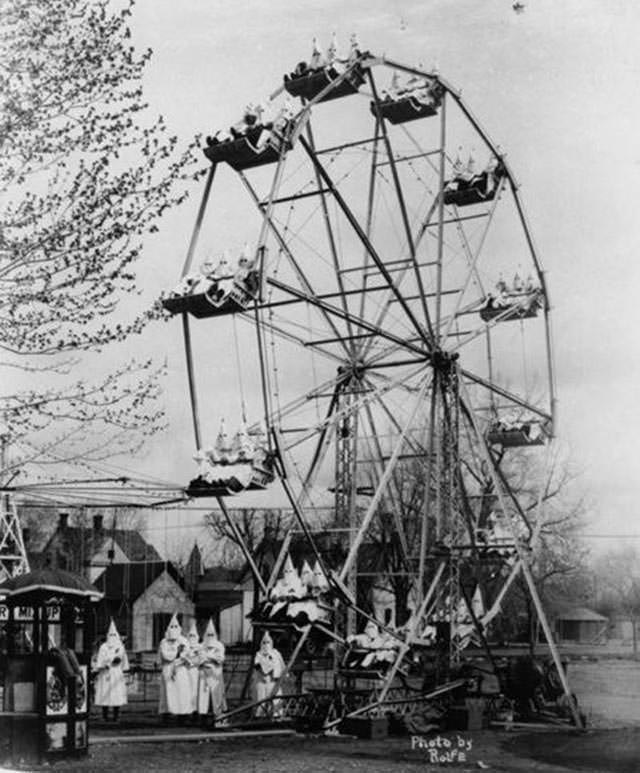
A Ferris wheel rises over Canon City’s carnival grounds while robed, hooded figures gather below and ride in the swinging cars, turning a familiar scene of small-town amusement into something deeply unsettling. The stark contrast between the playful machinery, the modest buildings in the background, and the uniformed crowd speaks to how openly the Ku Klux Klan could appear in public life in 1925. Even at a distance, the pointed hoods and coordinated presence read like a performance meant to be seen.
Carnivals were designed for laughter, spectacle, and shared community space, yet the Klan’s participation shows how intimidation could be woven into everyday events. The image’s composition—clusters on the ground, more perched high above—suggests a deliberate visibility, as if claiming the fair itself as a stage. Looking closely, the ordinary details of the setting become important: trees without leaves, simple streets, and fair structures that could belong to countless American towns, underscoring that this was not a hidden gathering.
For readers searching terms like “Ku Klux Klan Canon City 1925” or “KKK carnival photo,” this photograph offers a vivid entry point into the Klan’s public relations era, when rallies and parades often blended into civic life. Any “funny” first impression quickly collapses under the weight of what the robes represent—organized racism presented as normal entertainment. Preserved as a historical record, the scene invites reflection on how communities tolerated, resisted, or were pressured by such displays, and why remembering that normalization matters.