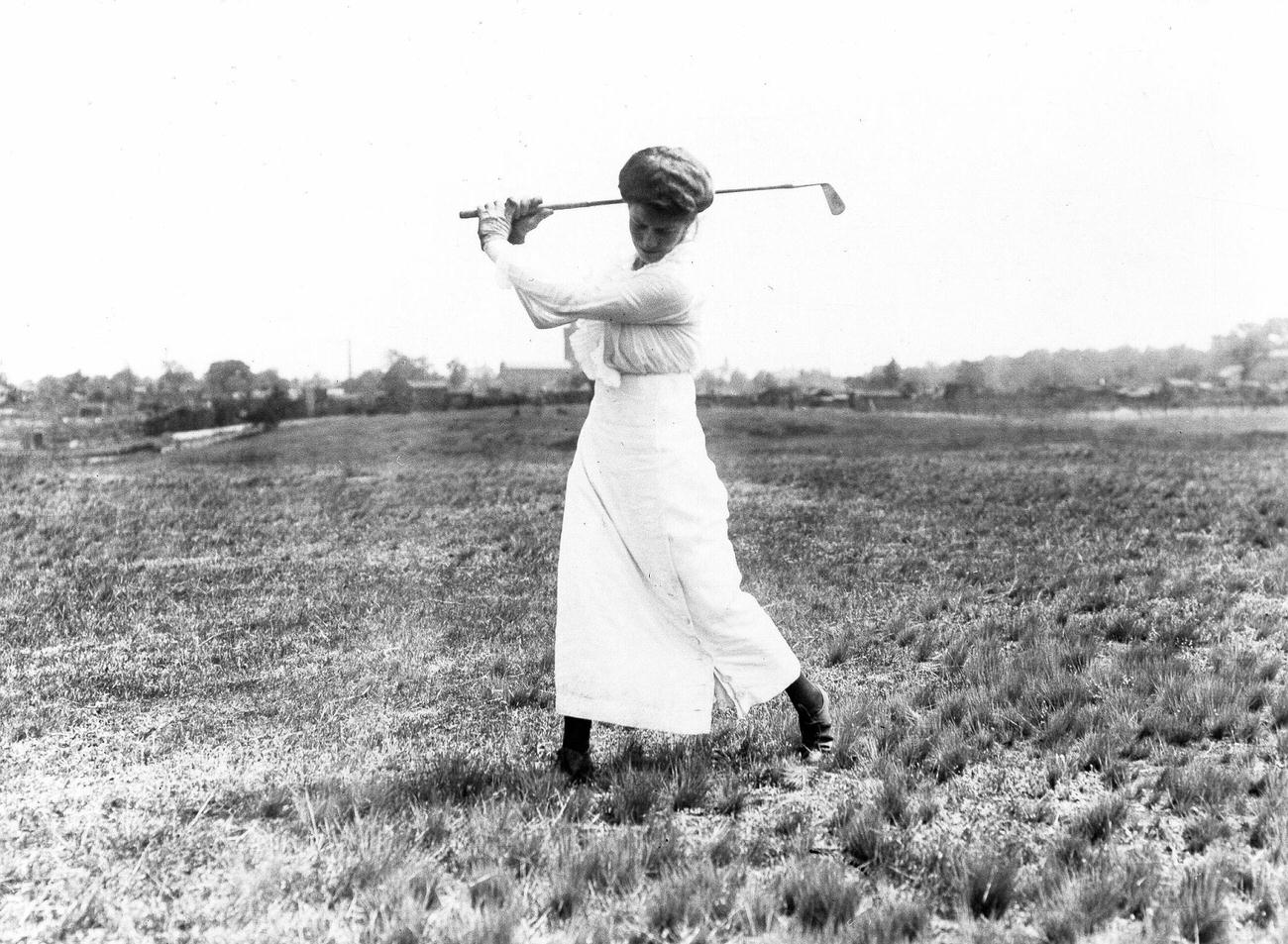
A golfer pauses in mid-swing on the open fairway at Berlin Golf Club Westend, her club lifted high as if the air itself might carry the ball’s direction. The long skirt, fitted blouse, and sturdy footwear speak to the era’s expectations of women’s dress while still accommodating the athletic motion of the game. Behind her, the landscape stretches low and quiet, with distant buildings and trees forming a soft horizon that keeps the focus on the player’s poised concentration.
Taken in 1919 by photographer Conrad Huenich, the scene belongs to a moment when everyday leisure was being renegotiated after upheaval, and modern sport offered a different kind of rhythm. Golf here looks less like spectacle and more like practiced discipline—an individual meeting the course with balance, grip, and timing. The photograph’s bright sky and broad field emphasize space and freedom, qualities often associated with the appeal of golf in early twentieth-century Europe.
For readers interested in women’s sports history, early golf photography, or Berlin’s social life between tradition and change, this image provides a vivid point of entry. It hints at the growing visibility of women on the greens and the way clubs and courses became stages for new public identities. As a historical photo, it invites close attention to posture, clothing, and setting—small details that reveal how sport, gender, and modern leisure intersected at Westend in the years after the First World War.