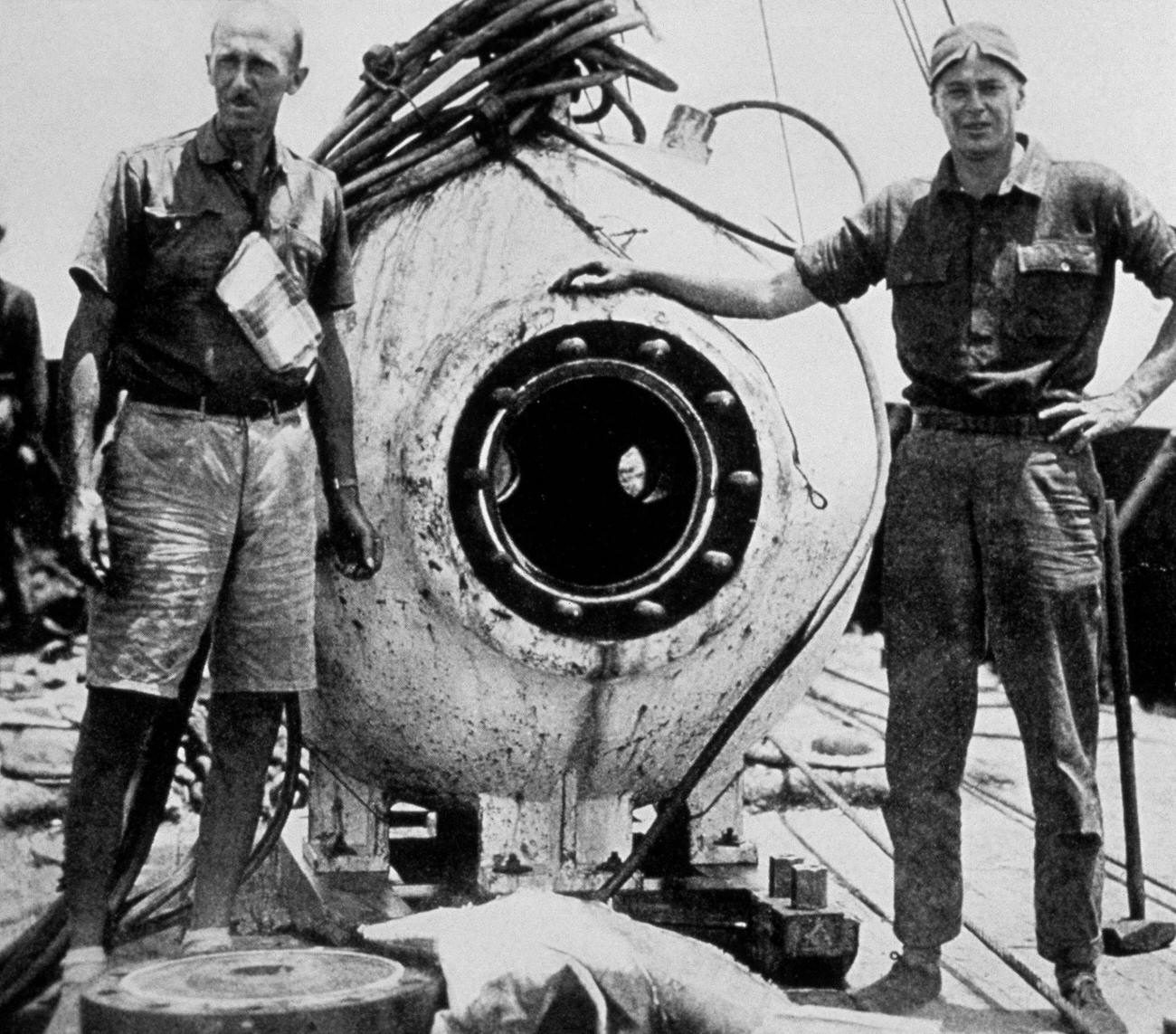
On the deck, marine biologist William Beebe and engineer Otis Barton stand beside the bathysphere, its riveted steel body dominated by a single round viewing port. The men’s practical work clothes and calm, steady poses contrast with the machine’s stark, industrial presence, reminding us that deep-sea exploration in the early 20th century depended as much on improvisation and grit as on grand ideas. Coiled lines, cables, and shipboard clutter frame the scene, hinting at the careful handling required to lower such a heavy, compact vessel into open water.
Bermuda, noted in the title, evokes clear Atlantic seas and dramatic depths—an ideal natural laboratory for an era hungry to push beyond the limits of surface observation. The bathysphere itself reads like a promise: a sealed sphere designed to withstand crushing pressure while granting a narrow but revolutionary window into the deep. In an age before sleek submersibles and live video feeds, that small porthole represented a new way of seeing, turning the ocean from an abstract frontier into a place that could be directly witnessed and described.
What makes this historical photo so compelling for collectors and researchers is the meeting of disciplines it embodies: biology and engineering, curiosity and fabrication, expedition and experiment. Beebe and Barton are presented not as distant celebrities of science, but as working partners beside their invention, suggesting the teamwork behind early oceanographic breakthroughs. For anyone interested in the history of marine biology, underwater technology, or classic exploration photography, this image stands as a vivid snapshot of how the bathysphere helped reshape our understanding of life far below the waves.