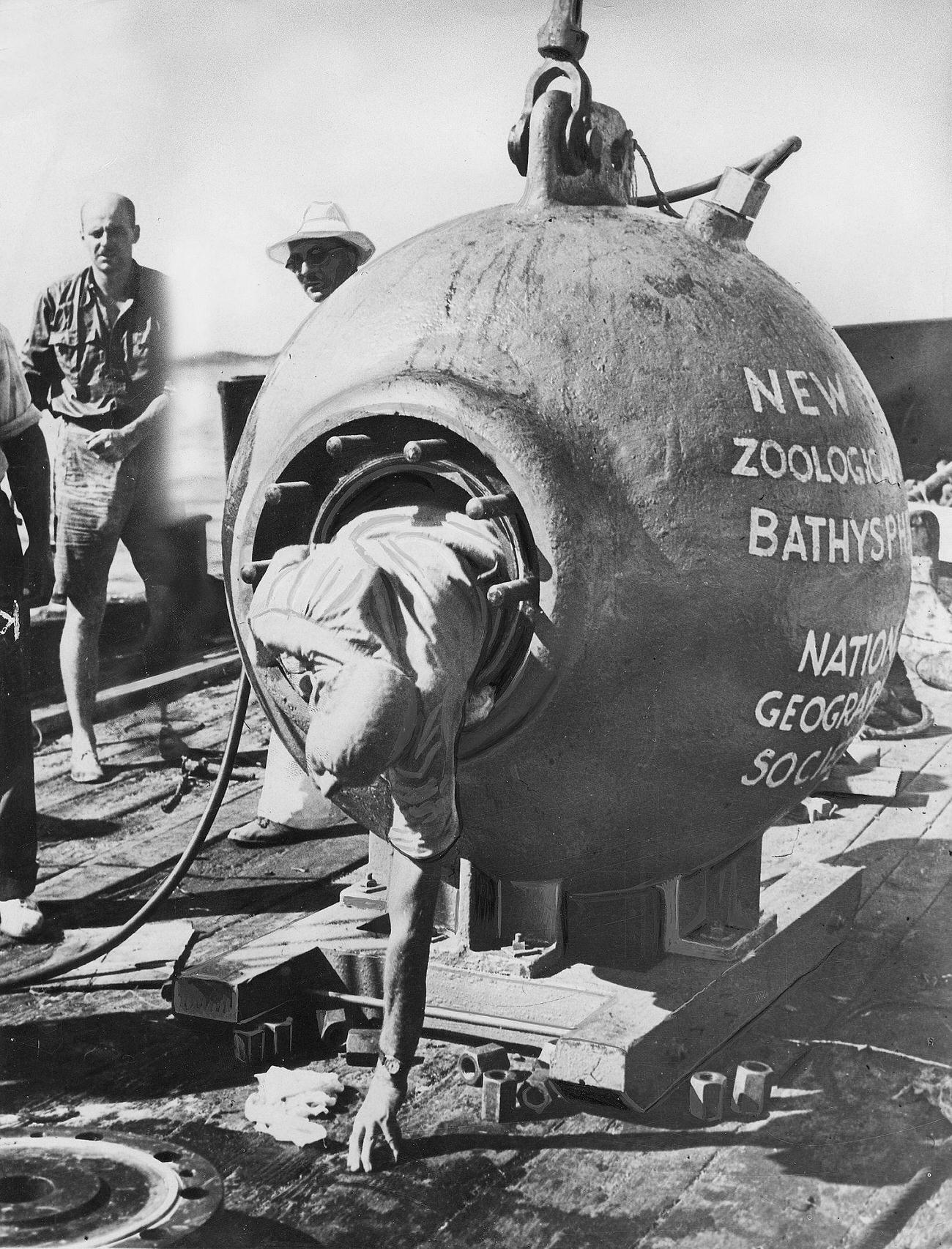
Sunlight glints off the scarred metal skin of the Bathysphere as William Beebe wriggles out through its circular hatch, one arm braced on the deck after hours sealed inside a deep-sea diving sphere. The heavy bolts around the opening, the thick cable snaking away, and the crane hook above hint at the precarious choreography required to lower a human into the ocean’s depths and bring him back safely. Nearby onlookers in work clothes watch with a mix of routine and awe, as if accustomed to the spectacle yet still mindful of what just happened beneath the surface.
Painted lettering on the sphere—partly readable as “NEW… ZOOLOGI… BATHYS…” and “NATION… GEOGRA… SOCI…”—anchors the moment in the world of early 20th-century exploration and science publicity. Bermuda, August 1934: a place and time when the frontier of discovery was not only polar ice or high mountains, but the dark water column where pressure and cold rewrote the rules. Beebe’s return to open air becomes a quiet victory for engineering as much as for zoology, proof that a compact steel chamber could serve as a window into a previously unreachable realm.
The deck is cluttered with rings, fittings, and tools, reminding us that pioneering oceanography depended on hands-on improvisation as well as grand ideas. In an era before sleek submersibles and digital sensors, the Bathysphere embodied invention—simple in outline, brutally strong in purpose—and it carried researchers close enough to describe deep-sea life as observation rather than rumor. For readers drawn to maritime history, underwater exploration, and the origins of modern marine science, this photo captures the human scale of risk, curiosity, and machinery at the threshold between sea and sky.