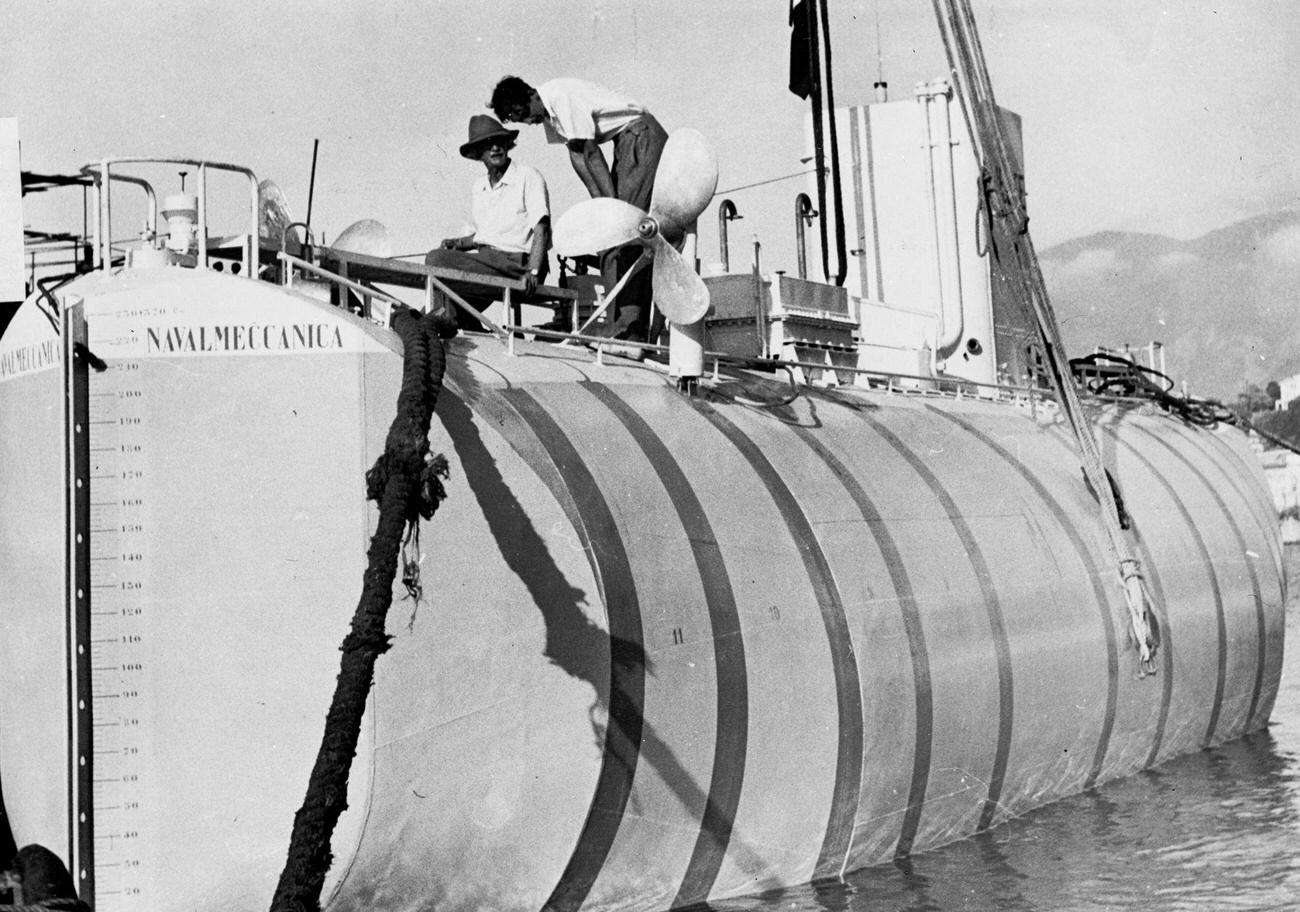
Alongside the calm surface of the harbor, Professor Auguste Piccard’s bathyscaphe sits like a floating cylinder of ambition, its striped hull stretching across the frame while crew members steady themselves on the narrow platform above. A crane looms nearby, suggesting the careful choreography required to launch and recover an experimental deep-sea vessel. Even without a dramatic seascape, the photo conveys the practical, hands-on reality of ocean exploration in the early 1950s.
Details on the craft hint at its purpose: a prominent scale marked down the side reads like a promise of depth, and the visible propeller and rigging speak to controlled movement rather than mere submersion. The title’s claim—capable of diving to 13,000 feet—places this bathyscaphe among the milestone inventions that pushed engineering beyond the limits of conventional submarines. It’s a portrait of machinery built for pressure, darkness, and the unknown.
Few inventions illustrate mid-century scientific daring as clearly as the bathyscaphe, an answer to questions that could only be asked by physically going down into the deep. This 1953 scene captures the moment when cutting-edge marine technology was still tangible enough to be examined from arm’s length, with metal, ropes, and measurements plainly visible. For readers searching for Professor Auguste Piccard, bathyscaphe history, or early deep-sea exploration technology, the photograph offers a grounded glimpse into the era that helped open the ocean’s deepest frontiers.