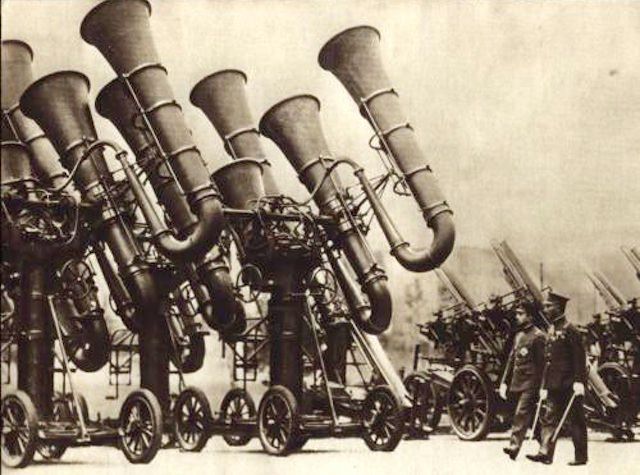
Rows of towering, trumpet-like listening devices dominate the scene, each horn mounted on a wheeled carriage and angled toward the open sky. Uniformed personnel stand nearby, dwarfed by the oversized “ears” and the tangle of supports, pipes, and cables that suggest an early blend of acoustics and electricity. The sheer scale of the apparatus makes the purpose unmistakable: to gather faint sounds from far away and amplify them into something a human could act on.
Before radar became widespread, air-defense forces relied on mechanical and electro-acoustic detection to hear approaching aircraft, and Japan experimented with strikingly ambitious versions of that idea. Multiple horns working together could be tuned and directed, helping operators estimate direction and distance by comparing sound intensity and timing. In the background, more equipment lines up in formation, reinforcing the sense of a coordinated system rather than a single oddball invention.
For readers interested in military technology history, interwar innovation, and the evolution of early warning systems, this 1936 photograph offers a vivid snapshot of a transitional moment. The “Japanese electric ears” look almost theatrical, yet they represent serious engineering under the pressure of modern aerial warfare. Long before electronic screens and rotating antennas defined air defense, these gigantic acoustic trumpets were an attempt to listen for danger and buy precious minutes of preparation.