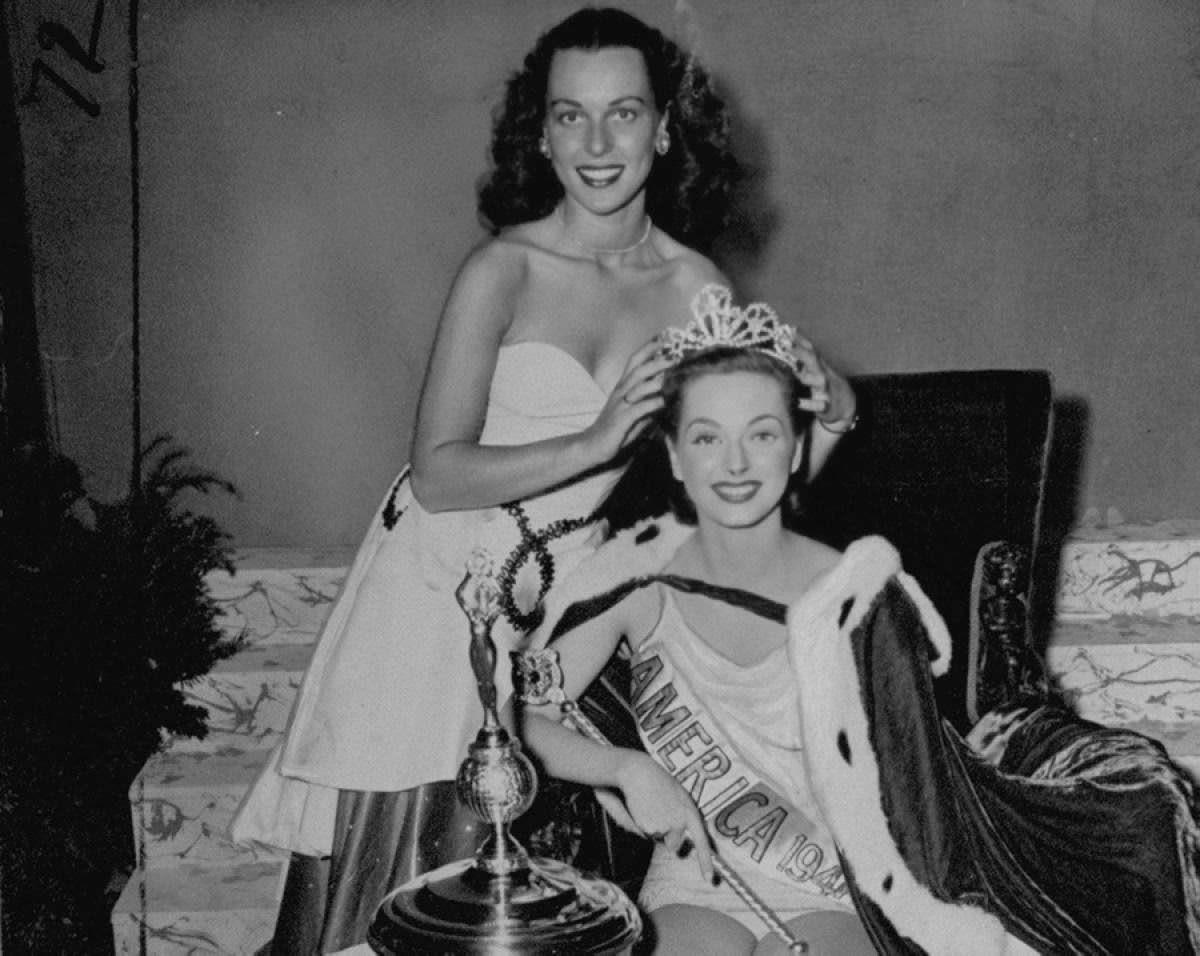
Poised behind the winner’s chair, Bess Myerson leans in to settle a sparkling crown on Marilyn Buferd, sealing the ceremonial handoff that defines the Miss America tradition. Buferd smiles toward the camera with practiced composure, her “America” sash cutting diagonally across a strapless gown while a fur-trimmed cape pools at her shoulder. In the foreground, a polished trophy anchors the scene, its shine echoing the pageant’s promise of glamour and achievement.
Even in a quiet, studio-like setting, the details speak to postwar fashion and culture: sculpted curls, bright lipstick, and the clean lines of eveningwear designed for spotlights and newspaper flashbulbs. The winners’ regalia—crown, sash, cape, and cup—functions like a visual checklist of victory, instantly legible to audiences who followed beauty pageants as mainstream entertainment. The composition tightens attention on the ritual itself, turning a brief moment into an emblem of American show business.
Beyond the glitter, the photograph reflects how early Miss America pageants blended aspiration with performance, elevating contestants into national symbols while packaging femininity as spectacle. Myerson’s steady hands and Buferd’s composed smile suggest both teamwork and transition, a public-facing exchange of status that would travel through magazines and local headlines. For collectors and researchers of Miss America history, mid-century pageantry, and women’s fashion, this coronation image offers a crisp snapshot of the era’s ideals and its carefully staged charm.