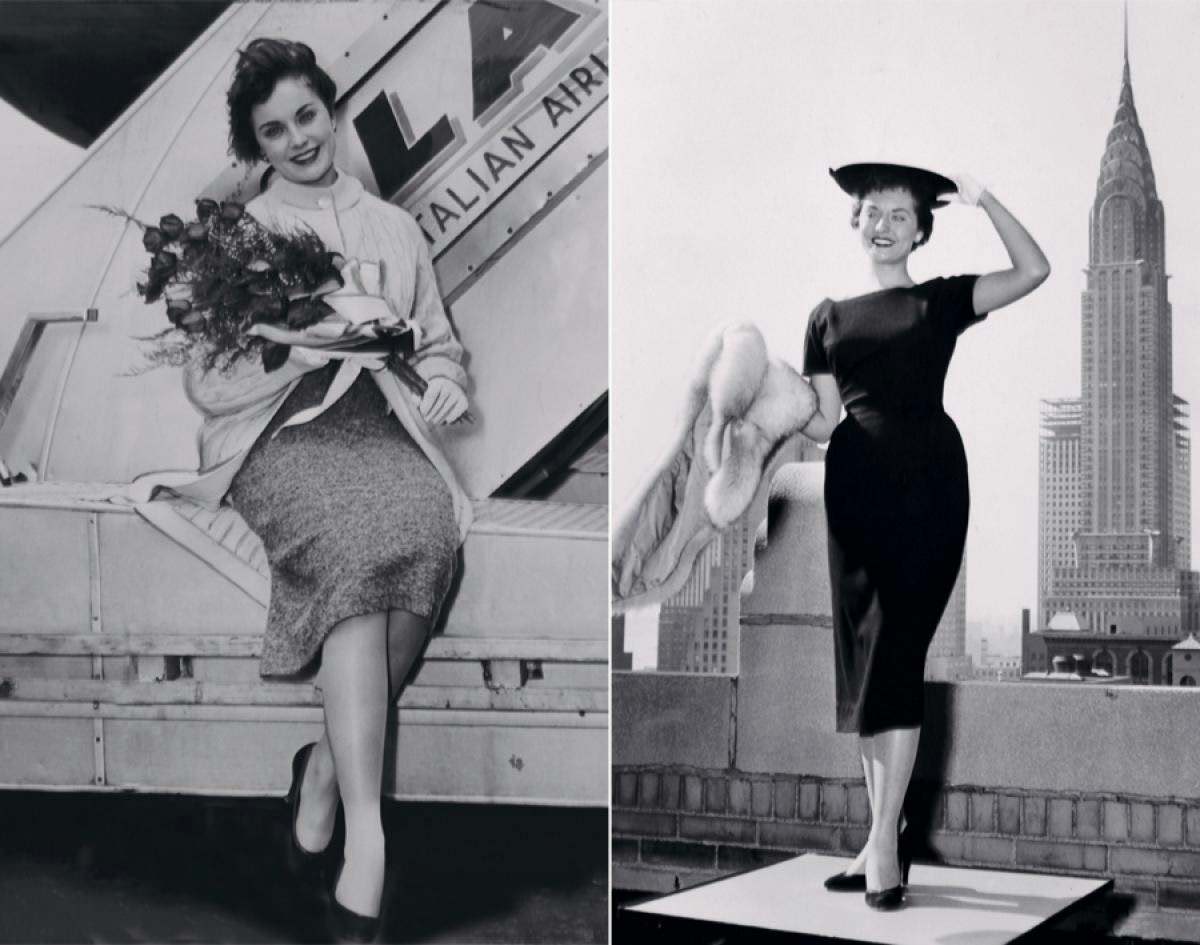
Fresh from overseas appearances, Sharon Ritchie—crowned Miss America 1956—poses on an airplane stairway with an armful of roses, her tailored coat and pencil skirt projecting the polished confidence expected of a mid-century goodwill ambassador. The aircraft behind her, marked with “Italian Air,” hints at the jet-age romance surrounding postwar travel, when beauty queens and celebrities helped sell the idea of a smaller, more connected world. Her poised smile and careful styling read like a publicity moment designed for newspapers and wire services as much as for the crowd waiting beyond the frame.
Across the paired photograph, Ritchie stands in a sleek, dark sheath dress and structured hat, one hand raised in a salute-like gesture that feels equal parts playful and ceremonial. A dramatic skyline rises behind her, with an Art Deco skyscraper anchoring the background and linking the pageant’s glamour to modern American urban identity. The composition—clean lines, strong silhouette, and a wind-tossed wrap—turns her into a figure of aspirational fashion and culture, balancing elegance with a sense of motion.
Taken together, these images speak to the Miss America pageant’s mid-1950s role as both entertainment and cultural messaging, where the titleholder’s schedule often resembled a diplomatic tour as much as a personal victory lap. The roses are more than a welcome; they are a prop of celebration and a symbol of public affection, carefully staged to reinforce the narrative of charm, respectability, and international reach. For historians of fashion, celebrity, and postwar media, the photographs offer a crisp window into how glamour was packaged, traveled, and received in 1956.