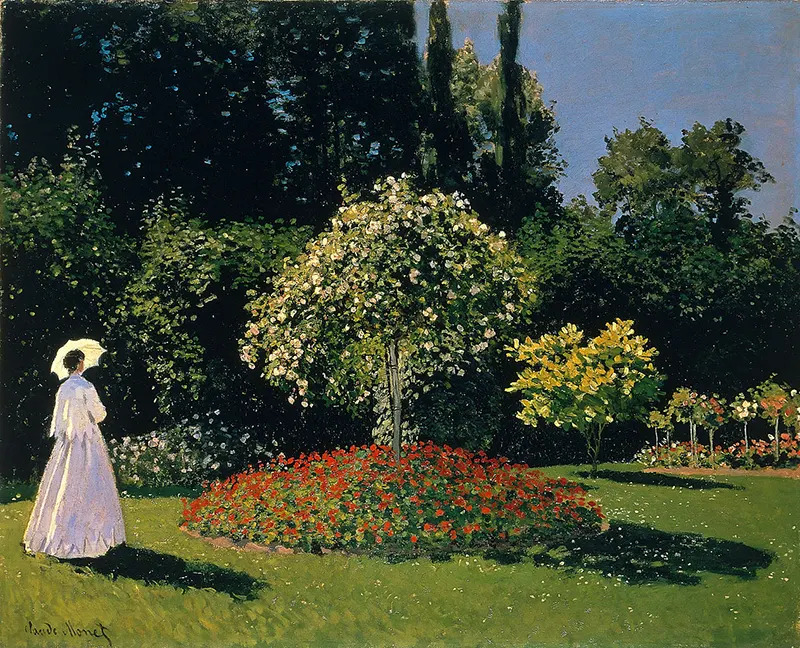
Afternoon light pools across a manicured lawn at the Hermitage in St. Petersburg, where a solitary woman in a pale dress pauses beneath a white parasol. She stands at the edge of a wide bed of red blossoms, her figure set against dense, cool greenery that rises like a wall behind her. The composition feels quiet and deliberate, inviting the eye to travel from sunlit grass to shadowed foliage and back again.
What makes “Woman in the Garden, 1867” so compelling is its patient attention to how sunlight fractures into color—yellow-green highlights on leaves, deeper tones in the hedges, and a soft haze where sky peeks through tall, dark trees. The woman is almost secondary to the atmosphere; her bright silhouette reads as another note in the painting’s orchestration of contrast. Even the crisp shadow on the lawn becomes a subject, measuring time as surely as the garden’s careful geometry measures space.
Garden scenes like this carry the promise of leisure, yet they also preserve a record of taste: orderly borders, curated plantings, and the fashionable ritual of strolling with a parasol. For readers searching for Hermitage art, St. Petersburg garden imagery, or studies of light and shadow in 19th-century painting, this work offers a vivid example of color used as observation rather than ornament. It’s a moment that feels both intimate and public—one person alone, yet framed by a landscape designed to be seen.