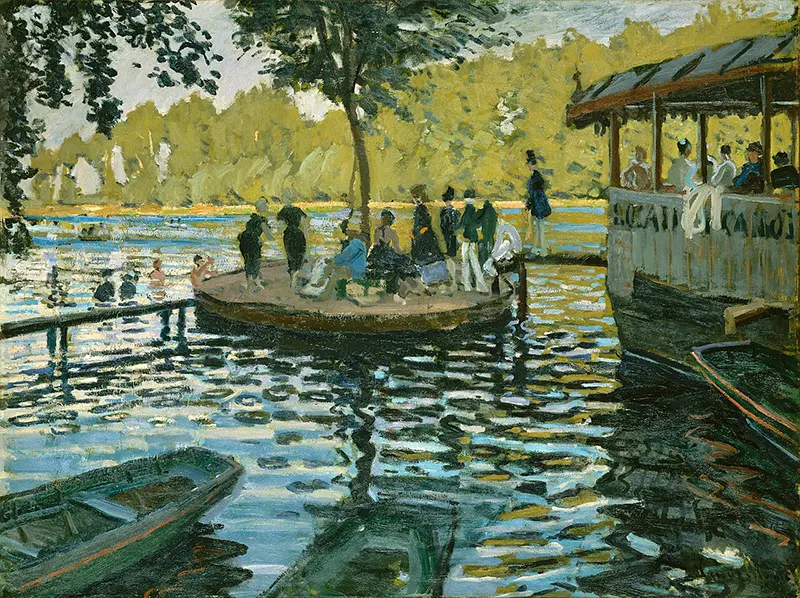
Sunlight flickers across rippling water in *La Grenouillére* (1869), a small plein-air painting now in the Metropolitan Museum of Art, New York, where broad strokes of intense colour turn an afternoon outing into a living atmosphere. Boats drift in the foreground, their dark hulls cutting through shimmering reflections, while a small island-like platform draws the eye toward clusters of figures gathered at the water’s edge. The trees beyond form a soft wall of green and gold, suggesting warm weather and the easy rhythm of leisure.
Along the central landing, silhouettes in dark clothing stand and sit beneath a single tree, their gestures summarized rather than detailed, as if the painter wanted movement more than portrait likeness. To the right, a covered structure—part pavilion, part riverside haunt—leans over the water, its railings and shadows painted with brisk confidence. Between these elements, the surface of the river becomes the true subject: layered blues, greens, and whites describe shifting light, current, and depth with a modern, almost instantaneous touch.
Viewed today, the work reads like a snapshot of outdoor sociability—boating, bathing, conversation—filtered through the radical immediacy of plein-air technique. The composition balances bustling human activity with an emphasis on light and reflection, inviting close looking at how quick marks build a convincing sense of place. For readers searching the Metropolitan Museum of Art collection or exploring 19th-century plein-air painting, this scene offers a compact lesson in how intense colour and abbreviated forms can evoke an entire season, soundscape, and mood.