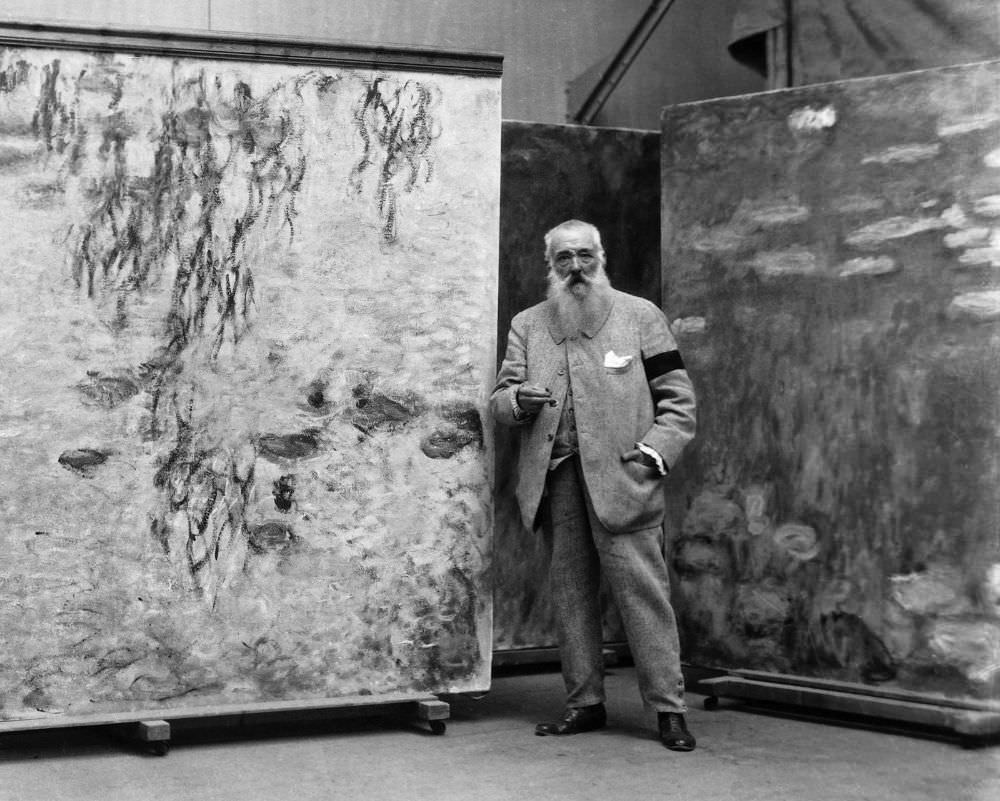
Between towering canvases on wheeled supports, an elderly bearded painter stands as if caught mid-thought, one hand poised while the other settles into his pocket. The studio setting feels both monumental and intimate: immense panels lean like walls, their surfaces alive with soft tonal shifts that suggest water, foliage, and drifting light. In this moment, Claude Monet appears less like a public legend and more like a working craftsman inside the very world he built stroke by stroke.
Giverny’s gardens hover in the background of every mark, even indoors, where painted reflections and blurred blossoms seem to expand the room beyond its edges. The compositions visible here evoke the language of the water-lily series—floating forms, veils of atmosphere, and a horizon that dissolves into sensation. For readers searching Claude Monet Giverny studio photos, this historical view offers a rare, grounded bridge between the cultivated landscape outside and the immersive artworks taking shape within.
What makes the scene so compelling is its scale: the panels dwarf the figure, hinting at the ambition behind Monet’s late work and the physical labor required to move and rework such vast paintings. The garden was not merely a motif but a personal laboratory, where light could be studied day after day and translated into paint until nature became memory and music. As a WordPress post companion, this image invites you to step into Monet’s personal eden and consider how the studio at Giverny turned private observation into enduring Impressionist art.