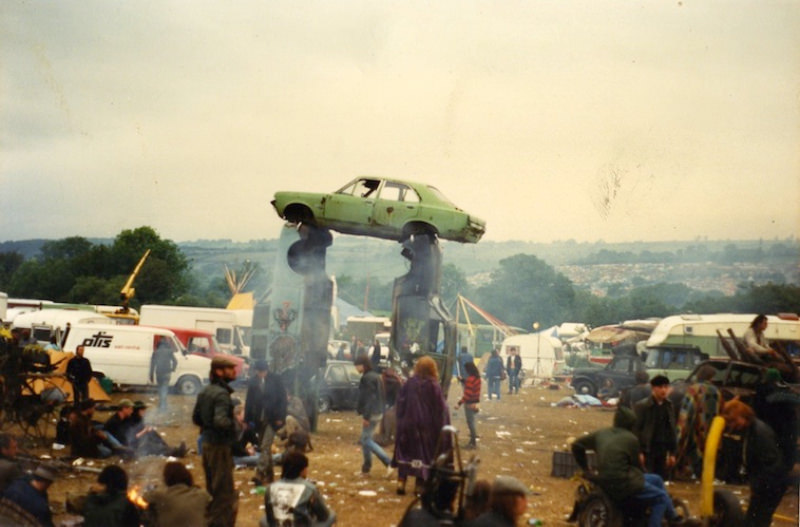
A battered green car hangs improbably overhead, balanced like a trophy on towering metal uprights while smoke drifts across a crowded field. Around it, people mill between vans and makeshift structures, the ground scattered with debris that hints at a long day—and night—of noise, movement, and spectacle. The whole scene feels like a pop-up scrapyard turned open-air gallery, where wreckage is staged as a monument rather than hauled away.
Mutoid Waste Company’s 1980s aesthetic lives in this kind of engineered chaos: repurposed auto parts, welded frames, and machines transformed into confrontational public art. The elevated car reads as both sculpture and provocation, a statement about consumption, waste, and the thrill of building something strange from what society discards. It’s industrial bricolage with a punk edge, inviting viewers to look up—literally—and reconsider the life of an object after its “useful” years are over.
For anyone searching the history of scrap car art, post-industrial sculpture, or the wider underground art culture of the 1980s, this photo offers a vivid snapshot of that do-it-yourself ethos in action. Instead of a quiet museum setting, the work appears amid a temporary community of onlookers, vehicles, and improvised infrastructure, suggesting that the performance of display mattered as much as the artifact itself. The result is a memorable reminder that some of the era’s most bizarre artworks were built from ordinary metal, shared in public, and meant to be felt as much as seen.