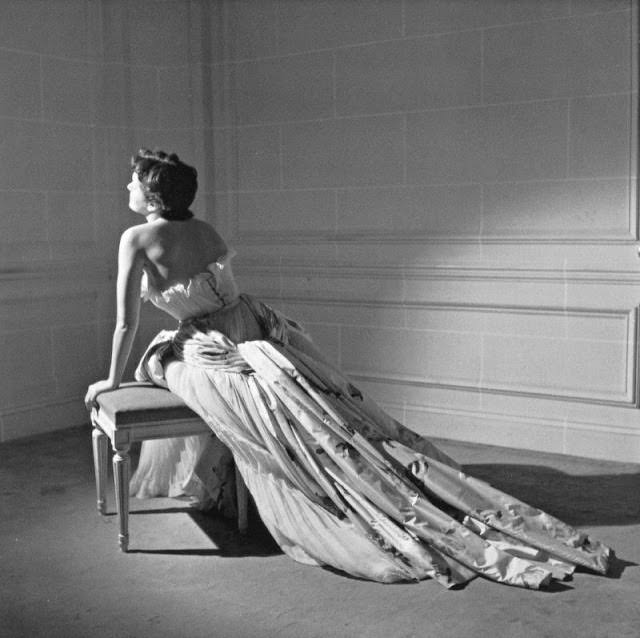
Maxime de la Falaise poses in profile, perched on a low upholstered bench as light spills across a paneled wall behind her. The strapless Christian Dior ball gown—named “Henri Sauguet,” as the title notes—falls away into a long, lavish train that pools on the floor like a painted ribbon. Her bare shoulders and turned head create a sense of poised anticipation, as if she has paused mid-evening to listen for music in the next room.
Dior’s celebrated 1950 silhouette is all about contrast: a fitted bodice that sculpts the torso, then an explosion of volume and length that dramatizes every movement. The fabric reads as softly lustrous in grayscale, with hints of floral or appliqué detail along the sweeping back that catch the light and deepen the texture. In this quiet studio-like setting, the gown’s architecture becomes the subject, turning couture into a landscape of pleats, folds, and shadow.
Fashion and culture intertwine here in a single, theatrical gesture—one model, one dress, and an atmosphere of postwar elegance. The restrained backdrop emphasizes the New Look’s promise of glamour, while the pose highlights the craft of haute couture meant for grand entrances and lingering exits. For readers searching classic Dior, 1950s eveningwear, or Maxime de la Falaise style, the photograph offers an enduring study in how couture was staged, worn, and remembered.