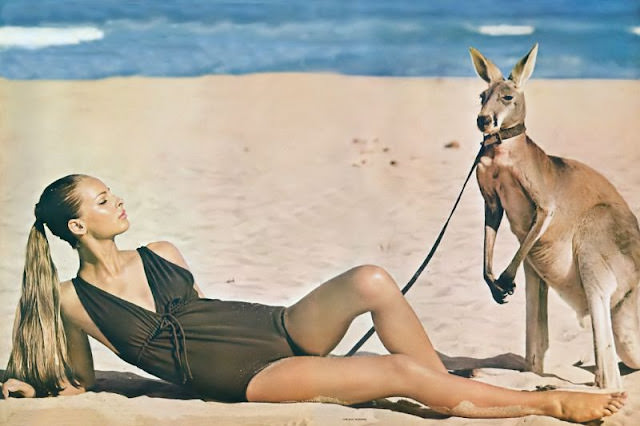
Sunlight turns Wanda Beach into a clean stage of sand and sea, where Camilla Sparv reclines with the poised ease of a fashion tableau. The brown Empire‑waist maillot gathers at the bust and falls into a sleek, sculptural line, emphasizing mid‑century swimwear’s move toward elegant minimalism. Her slicked-back hair and relaxed, elongated pose echo the era’s magazine polish while keeping the mood unmistakably coastal and Australian.
Alongside her, a kangaroo stands alert, tethered on a leash that cuts a dark diagonal across the pale beach—an unforgettable juxtaposition of high fashion styling and local wildlife. The animal’s upright stance and watchful ears create a counterpoint to Sparv’s languid calm, making the composition feel at once playful, surreal, and sharply controlled. Behind them, the soft blur of blue water and distant surf reads like a simple backdrop, letting texture—skin, fabric, fur, and sand—carry the visual story.
Set in May 1964, the photograph belongs to the vibrant moment when 1960s fashion photography leaned into bolder narratives and travel imagery without losing its emphasis on form. Beachwear here isn’t merely practical; it’s editorial, designed to be read from head to toe, from the tailored seams of the suit to the deliberate way the body is arranged against the shoreline. For viewers searching classic Helmut Newton fashion photography, Camilla Sparv, or Australian beach fashion history, this scene distills an era’s fascination with glamour, modernity, and the unexpected.