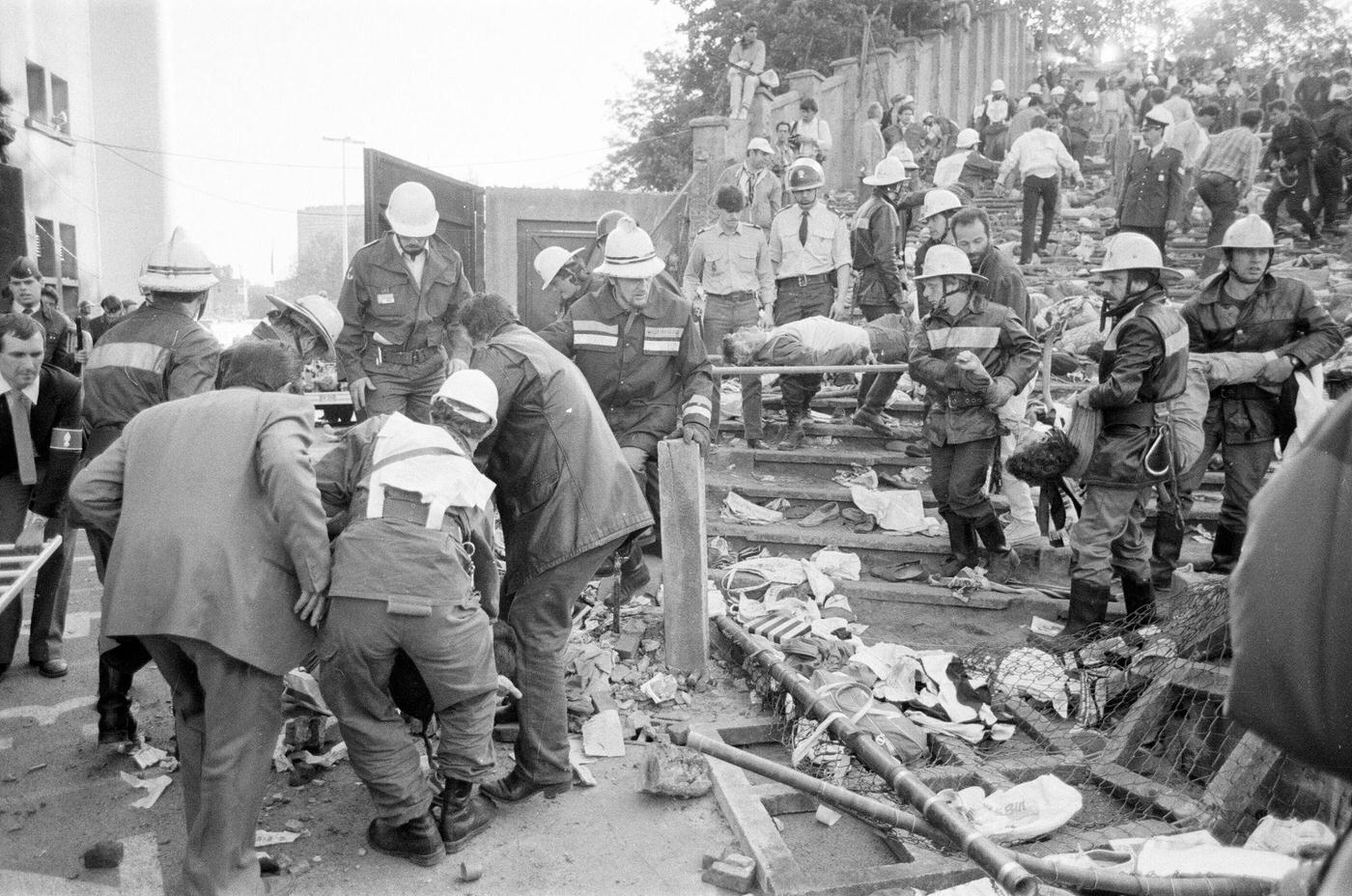
Chaos clings to every step in this scene from Heysel Stadium during the 1985 European Cup Final, where a crowd surge pressed supporters against a failing boundary and turned a night of football into catastrophe. Rescue workers in helmets move through littered terraces and broken masonry, their urgency mirrored by the stunned onlookers gathered along the shattered approach. The crumpled fencing and scattered debris underline how quickly a packed stand can become a trap when escape routes and barriers give way.
In the foreground, responders coordinate around casualties while others climb the damaged structure, scanning for survivors and clearing space amid the wreckage. The steep concrete tiers, now strewn with torn clothing, paper, and rubble, evoke the aftermath of a crush rather than the pageantry of a European final. Faces are hard to read at a distance, yet the posture of those present—bent to lift, reaching to help, or frozen in disbelief—tells its own story of panic and desperate improvisation.
Heysel remains a defining chapter in football history, not only for the lives lost but for the way it forced Europe to confront stadium safety, crowd management, and the real-world consequences of disorder. Photographs like this are painful to revisit, yet they serve as evidence of what failed—structures, segregation, and control—when too many people were pushed into too little space. For readers searching for the Heysel Stadium disaster, the 1985 European Cup Final, or the origins of modern safety reforms, this image offers a stark reminder of why those changes mattered.